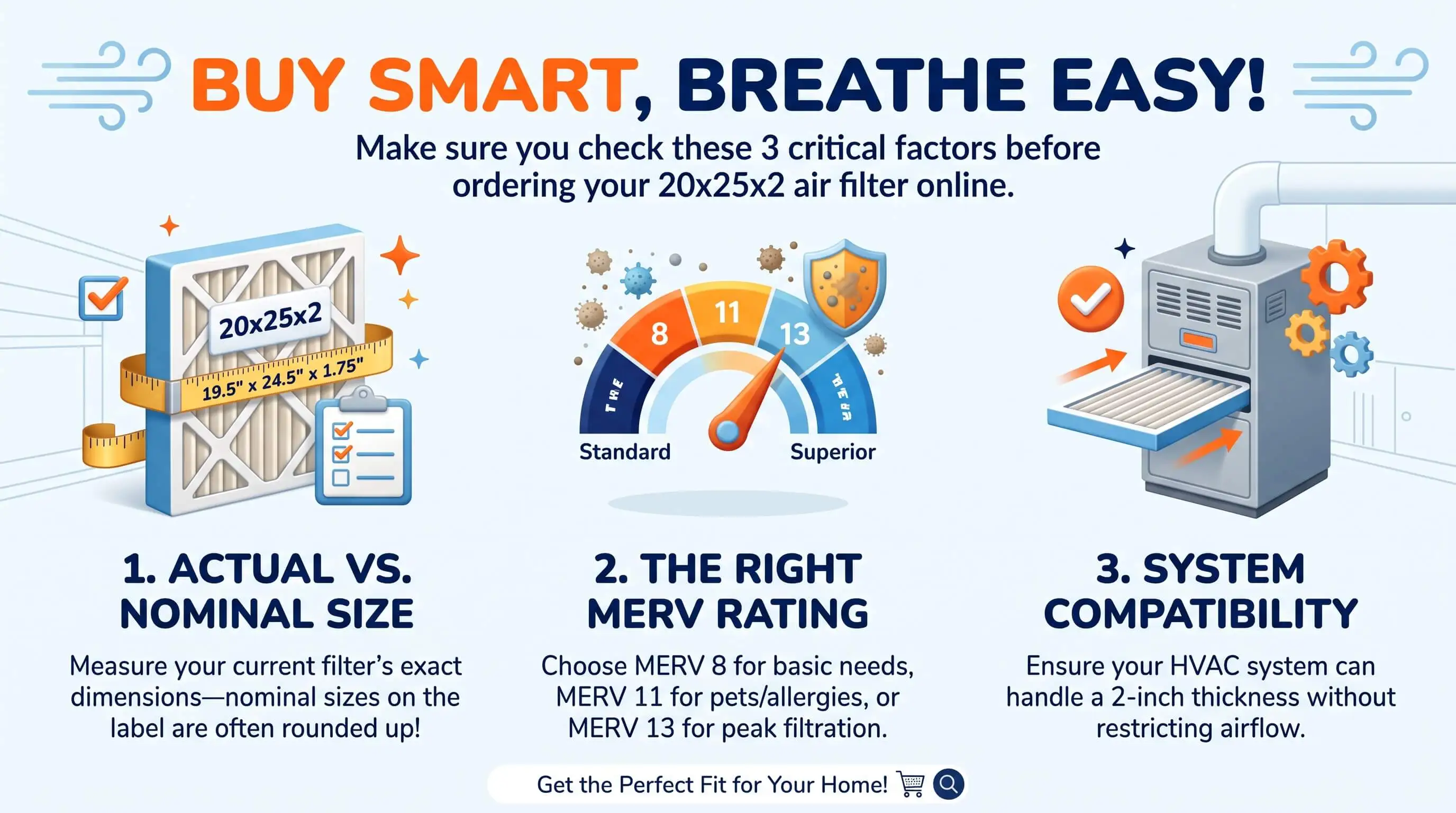
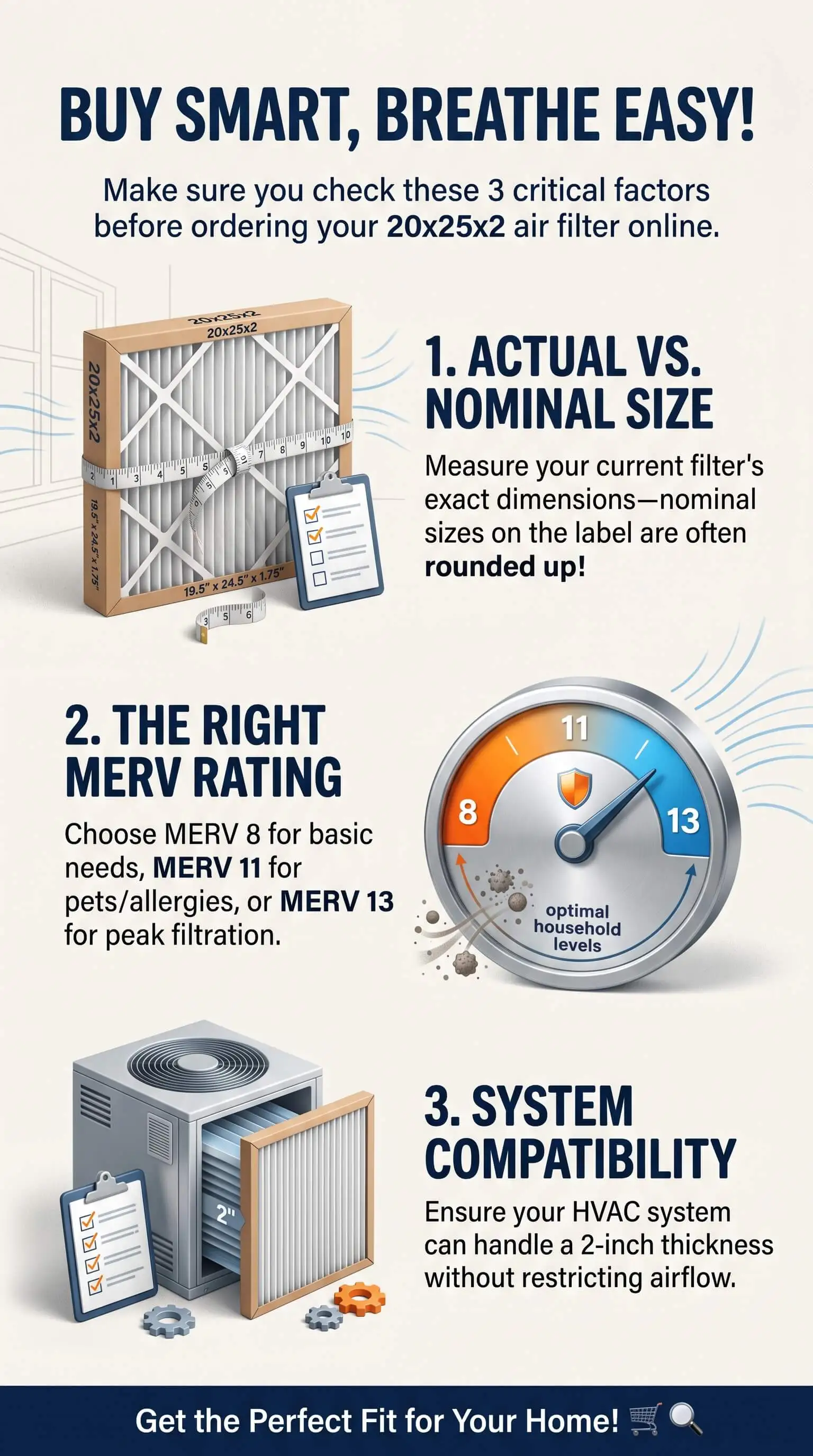
A 20x25x2 air filter doesn't actually measure 20 by 25 by 2 inches. Put a tape measure on one and you'll get something closer to 19½ by 24½ by 1¾.
That gap is on purpose. It's also where a lot of online orders go sideways, because 2-inch filters are harder to find on store shelves than 1-inch sizes, and most people end up buying online without the old filter in hand to compare. Your filter is the quiet line of defense for your family's air and the HVAC system that keeps your home comfortable year-round. Five minutes with a tape measure and a product listing is all it takes to get the order right the first time.
TL;DR Quick Answers
20x25x2 air filter
A 20x25x2 air filter is a 2-inch-deep pleated HVAC filter. Its nominal size is 20 x 25 x 2 inches, but it actually measures about 19½ x 24½ x 1¾ inches. It usually sits in a cabinet at the air handler, catches dust before it reaches your blower, and needs a fresh replacement about every 90 days.
Actual size: About 19½ x 24½ x 1¾ inches. It’s cut slightly small on purpose so it slides in and seals.
Depth: 2 inches. A 20x25x1 leaves a gap in this slot and lets air slip around the media.
Either label works: 20x25x2 and 25x20x2 are the same filter.
MERV rating: 8 for everyday dust, 11 for pets and allergies, 13 for fine particles and smoke. Choose the highest rating your system allows.
Replacement: About every 90 days in most homes. Change it at about 60 days with a pet, and closer to 45 with several pets or allergies.
Pro tip: Write the size and MERV rating on the air handler cabinet so every reorder takes thirty seconds.
Top Takeaways
20x25x2 is a nominal size, and the filter itself usually measures about 19½ x 24½ x 1¾ inches.
Depth decides fit. A 1-inch filter in a 2-inch slot lets air sneak around the media.
Pick the highest MERV your system was built for, with MERV 13 as the target for fine particles and smoke.
Budget for four filters a year, or more with pets or allergies.
Buy from listings that show actual dimensions and a stated MERV rating.
Does Your System Really Take a 20x25x2 Filter?
Size comes first, because nothing else matters if the filter doesn't fit. 20x25x2 is the nominal size, the rounded name printed on the box and the one you order by. The filter itself runs a little smaller, usually about 19½ x 24½ x 1¾ inches, so it slides into the track without binding.
Check the old frame. Most filters print the nominal size on the edge, and some list the actual size right beside it.
No filter in the slot? Measure the slot's length, width, and depth, then round each number up to the nearest whole inch.
Don't sweat the order of the numbers. Manufacturers list length and width either way, so a 25x20x2 is the same filter.
Then hold your numbers up against the product page before you check out. A trustworthy listing for 20x25x2 air filter in the exact cut states the real dimensions plainly instead of leaning on the nominal size alone.
Why Does Filter Depth Matter So Much?
Depth is the number people skip. It also causes the most trouble. A 20x25x1 and a 20x25x2 share the same face size, and they still can't stand in for each other.
A 1-inch filter sitting in a 2-inch track has about an inch of wiggle room, so it shifts, and air slips around the frame instead of moving through the media.
Stacking two 1-inch filters to fill the gap won't seal either, because the frames don't lock against each other or the track.
Going the other way fails faster. A 2-inch filter won't fit a 1-inch slot, and forcing it bows the frame.
Most 2-inch filters live in a cabinet at the air handler rather than behind a wall grille. That extra inch holds more pleated media, which gives dust more surface to settle on before airflow starts to fall off. This added capacity can reduce the frequency of air filter replacements while helping maintain steady airflow.
Which MERV Rating Should You Choose?
MERV stands for Minimum Efficiency Reporting Value, and it rates how well a filter catches particles between 0.3 and 10 microns. The higher the number, the smaller the particles the pleated particulate filter media can trap.
MERV 8 handles everyday dust, lint, and pollen.
MERV 13 is the rating the EPA and the National Air Filtration Association point to for fine particles, wildfire smoke included.
Listings rarely mention the trade-off. Every step up the scale adds a little resistance to airflow, so the best choice is the highest MERV your gas furnace blower and filter slot were built for. Your equipment manual should spell it out, and an HVAC technician can confirm it in a single visit. If your old filter shows an MPR or FPR number instead, know that those are retailer rating scales, and match them to MERV before you order.
What Should the Product Listing Tell You?
A good listing answers your questions before you think to ask them. I look for five things.
The actual dimensions, listed right next to the nominal size.
A stated MERV rating from standard testing, not fuzzy "MERV-equivalent" wording.
Disposable pleated media. Washing a pleated filter won't get it clean enough to catch fine particles again.
A frame stiff enough to hold its shape when the blower kicks on.
Plain pack sizes and return terms, in case a measurement turns out to be off.
When a listing skips any of them, I keep shopping.
How Many Filters Should You Order at Once?
Plan on four. Most homes swap a 20x25x2 about every 90 days, which works out to four filters a year. Pets shorten that to roughly 60 days, and a house with several pets or someone with allergies should aim closer to 45.
During long heating and cooling stretches, pull the filter once a month and hold it up to a light. When light stops coming through the pleats, it's done. This guide on how often to change your furnace filter covers a few more situations.
Multi-packs and scheduled delivery usually bring the per-filter cost down, and they take the remembering off your plate. Keep spares flat and dry in their original packaging.
Mistakes to Avoid When Ordering a 20x25x2 Filter Online
Ordering by face size and never checking depth.
Trusting the nominal size without comparing it to the actual dimensions on the listing.
Grabbing the highest MERV before confirming your system can push air through it.
Sliding the filter in backward. The airflow arrow points toward the blower, and this filter direction checklist shows you how to read it.
Buying one filter at a time and losing track of the next change.
Rinsing a pleated filter so you can reuse it.
"In my years servicing forced-air systems, I've pulled far more filters that leaked around the edges than filters that were simply dirty. Even a slightly undersized frame gives air an easier path around the media, and that unfiltered air carries dust straight onto the blower wheel and the coil."
Essential Resources
What Is a MERV Rating? (U.S. EPA): The EPA breaks down the MERV scale and recommends MERV 13 or the highest rating your system can handle.
Maintenance Checklist (ENERGY STAR): ENERGY STAR lays out seasonal HVAC upkeep, including a monthly filter check.
Maintaining Your Air Conditioner (U.S. Department of Energy): The Department of Energy shows how a clogged filter affects energy use and how often to check it.
Air Filters (American College of Allergy, Asthma and Immunology): Allergists explain why disposable MERV 11 to 13 filters make the most sense for allergy sufferers.
Don't Fear Your Furnace (National Center for Healthy Housing): Researchers looked at how often homeowners fall behind on filter changes.
Best Practice Guidelines for Residential HVAC Filtration (National Air Filtration Association): The filtration industry's own guidance on filter fit, air bypass, and choosing a MERV rating.
Preparing Your Home for Wildfire Smoke (Oregon DEQ): Oregon's environmental agency explains how to use high-efficiency HVAC filters when smoke rolls in.
Supporting Statistics
1. Heating and cooling use more than half of a home's energy.
Space heating and air conditioning accounted for 52 percent of household energy use in 2020.
When a filter chokes airflow, that system works harder to deliver the same comfort.
Source: U.S. Energy Information Administration, Residential Energy Consumption Survey.
2. About one in three Americans live with allergies.
More than 106 million people in the U.S. deal with allergies every year.
For a lot of households, picking a MERV rating is a health call as much as a maintenance one.
Source: Asthma and Allergy Foundation of America.
3. Nearly half the country lives with failing air.
152.3 million people, or 44 percent of Americans, live in places that earned a failing grade for ozone or particle pollution.
Outdoor particles drift indoors, and your HVAC filter is what catches them.
Source: American Lung Association, State of the Air 2026.
Final Thoughts and Opinion
Honestly, the filter is the easy part. The work happens before you hit order, and it takes a few minutes with a tape measure and your equipment manual. Match the actual size and depth, pick the highest MERV your system can handle, and a 20x25x2 air filter will quietly do its job for about three months at a stretch.
One habit I'd recommend to anyone is writing the full filter size and your MERV rating on the air handler cabinet in permanent marker. Every future order turns into a thirty-second job, and nobody else in the house has to guess. Little effort, big impact.
Frequently Asked Questions
Is a 20x25x2 the same as a 25x20x2?
Yes. Manufacturers list length and width in either order, so both labels describe the same filter. Just make sure the depth reads 2 inches and the actual size matches your slot.
Can I use a 20x25x1 in a 20x25x2 slot?
Not reliably. A 1-inch filter in a 2-inch track has roughly an inch of play, so it shifts, and air flows around the frame instead of through the media. Order the depth your cabinet was built to hold.
How often should I change a 20x25x2 air filter?
Every 90 days covers most homes. With a pet, move to about 60 days, and with several pets or allergy sufferers, closer to 45. Check it monthly when the system runs hard, and swap it early if the pleats look gray and packed.
Is MERV 13 too restrictive for a home system?
Most modern systems handle it fine, and both the EPA and the National Air Filtration Association recommend MERV 13 wherever the system allows. Older or undersized blowers can struggle, though. Check your manual or ask a technician, and pay attention to airflow at the vents after you switch.
Can I wash and reuse a pleated 20x25x2 filter?
No. Manufacturers build pleated filters to be replaced. Water damages the media and can't flush out the fine particles packed deep in the pleats, so a rinsed filter never performs like a fresh one.
Get the Right 20x25x2 Filter on the First Order
Grab a tape measure, confirm the depth, and match the MERV rating to what your system was built for before you place an order. Those few minutes turn a 20x25x2 air filter from a guess into the right fit for your home and everyone breathing its air.