Your HVAC system pulls air from every room, conditions it, and sends it back through every duct in the house. That’s how cooking byproducts from the kitchen get recycled into bedrooms and hallways every time the system runs. The range hood handles what rises directly above the burners. Everything else — the fine grease aerosols, the volatile organic compounds that give garlic and fish and curry their staying power — moves into that shared air supply. Effective air filters help capture more of what circulates through your system, supporting fresher indoor air throughout your home.
After manufacturing filters for over a decade, we’ve learned which filter combinations actually work in cooking-heavy homes. The rest of this page breaks it down.
TL;DR Quick Answers
air filters
An air filter is a replaceable media component installed in your HVAC system's return air path. Every time your system runs, it pulls household air through the filter before conditioning and redistributing it. The filter's job is to intercept what's floating in that air before it reaches your equipment and recirculates through your home.
After manufacturing filters for over a decade and serving more than two million households, here's what we know matters most:
What air filters capture: Dust, pollen, pet dander, mold spores, and fine particles — depending on the filter's MERV rating
What MERV measures: Particle capture efficiency on a scale of 1 to 16. Higher MERV = finer filtration. Most homes perform best between MERV 8 and MERV 13
What standard filters miss: Gaseous odors and volatile organic compounds (VOCs) require an activated carbon layer, which mechanical fiber media alone cannot capture
When to replace: Every 60 to 90 days for average households; every 30 to 45 days for homes with pets, allergies, or frequent cooking
Why fit matters: A filter with gaps around the frame lets unfiltered air bypass the media entirely — the right size is as important as the right rating
The filter sitting in your return grille right now is the only line of defense between your household air and your HVAC equipment. Choosing the correct MERV rating and replacing it on schedule are the two decisions that determine how well it does that job.
Top Takeaways
MERV 11 is the minimum recommended filter rating for households that cook with strong-smelling ingredients (garlic, fish, curry, fried foods) more than a few times per week. MERV 13 is the right choice for daily high-heat or high-intensity cooking.
Mechanical filters alone don’t remove cooking odors. VOC molecules, the gaseous phase of cooking smells, pass through standard pleated media. An activated carbon layer is what adsorbs them.
Cooking-heavy homes should replace filters every 30 to 45 days, not the standard 60 to 90. Yellowish-brown discoloration from cooking grease on the filter face is the reliable signal that it’s time.
A saturated filter restricts airflow and reduces HVAC efficiency, which means higher energy costs and added equipment wear regardless of air quality impact.
The range hood and HVAC filter work together. The range hood handles emissions at the source. The HVAC filter handles what escapes into the broader air supply. Both need to be working. Neither replaces the other.
Filter fit matters as much as filter rating. Gaps around an improperly sized filter allow unfiltered air to bypass the media entirely. Measure actual filter dimensions, not just the nominal size on the label.
Indoor VOC concentrations can reach 2 to 10 times outdoor levels during cooking activity, according to EPA research. Activated carbon filtration directly addresses the gaseous phase of that gap.
Why Cooking Smells Linger Longer Than You Expect
When you fry fish or simmer a long curry, the heat converts cooking oils into fine grease aerosols and releases volatile organic compounds into your kitchen air. The aerosols are small enough to stay suspended for extended periods before settling on surfaces throughout your home. VOCs move differently. Because they exist as gases at room temperature, airflow carries them wherever air goes.
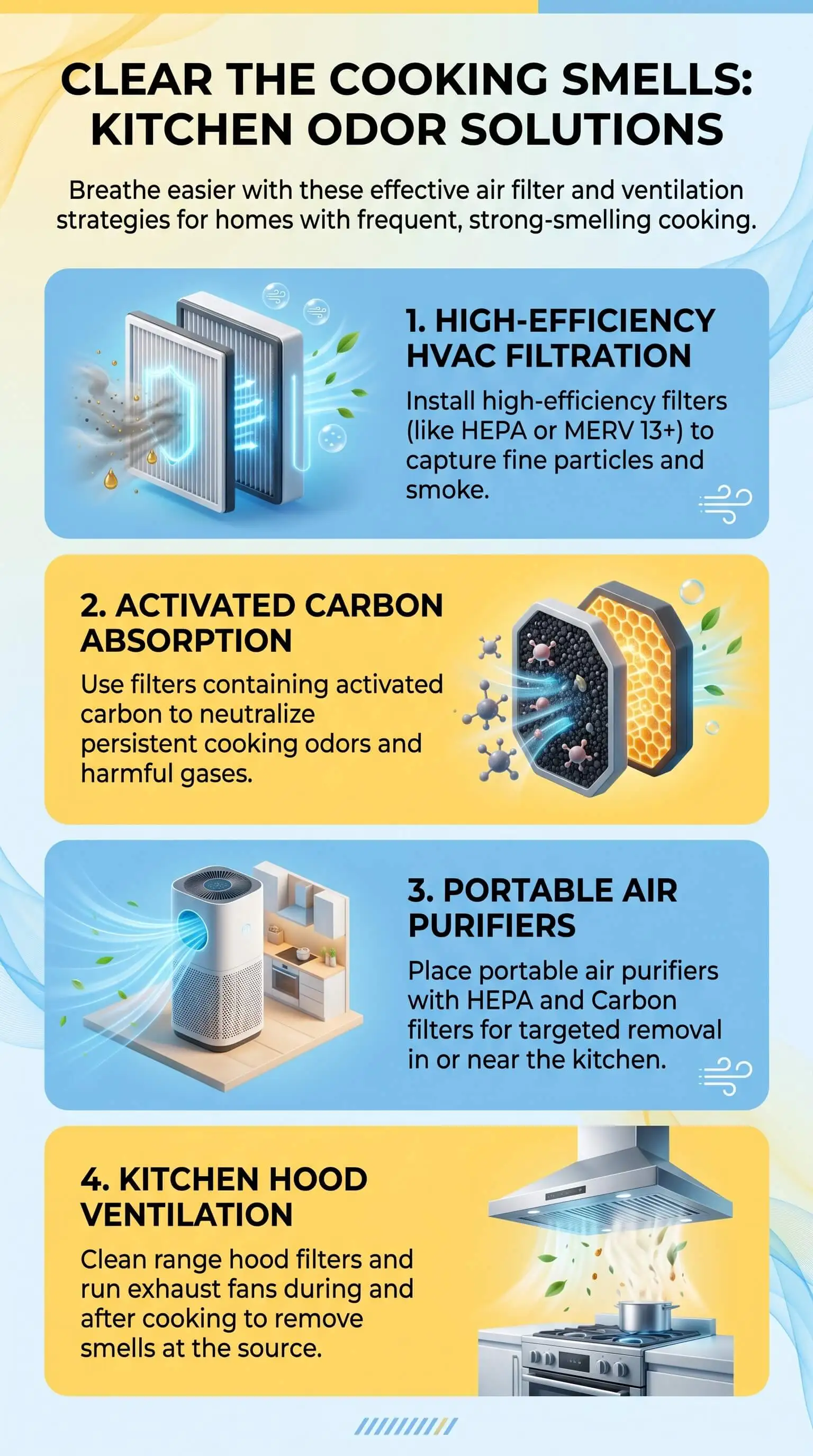
That’s where top air filters can make a meaningful difference. Your HVAC system pulls air from every room, conditions it, and distributes it through every duct, so a single cooking session can send byproducts into that shared air supply. Top air filters help capture more of what comes through, supporting cleaner circulation and making it easier to keep odors from lingering every time the system runs.
How Air Filters Trap Cooking Odors at the Source
Cooking creates two air quality problems, and each one requires a different filtration mechanism.
The first is particles. Pleated air filter media intercepts grease aerosols, cooking smoke particulates, and fine particles as air passes through the fibers. A higher MERV rating means finer fiber spacing and a greater percentage of particles caught per pass. That matters in a cooking-heavy home, where the particulate load is significantly heavier than ordinary household dust.
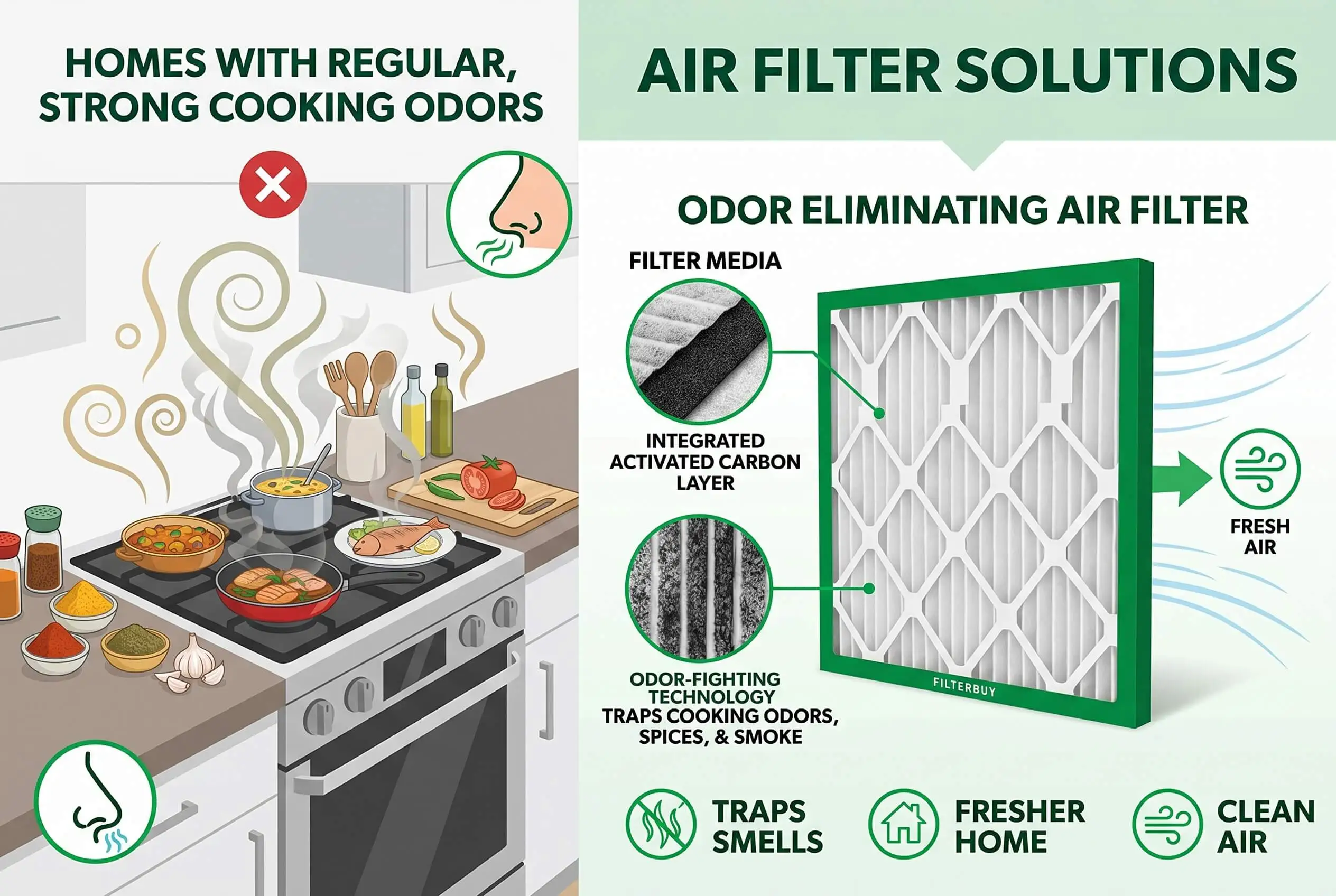
The second problem is gaseous. VOCs and odor-causing molecules produced during cooking exist as gases, not particles. Mechanical fiber media doesn’t stop them. Activated carbon does. As air contacts the carbon material, gas molecules bond to the surface through a process called adsorption — they stay attached rather than passing through. A filter that pairs pleated media with a carbon layer handles both sides of the cooking air quality problem. Particles get captured in the fibers. Gases get locked into the carbon.
The Right MERV Rating for Cooking-Heavy Households
MERV stands for Minimum Efficiency Reporting Value, the scale ASHRAE developed to measure how effectively a filter captures particles across specific size ranges. For a household where strong-smelling foods are a regular event, here’s how the MERV tiers break down in practice:
MERV 8: The entry-level threshold for meaningful particle capture. Works for occasional, light cooking. Not built for garlic, fish, fermented foods, or daily high-heat cooking.
MERV 11: The practical minimum for households where curry, fried foods, fish, or aromatic spices appear more than a few times a week. Captures a broader range of particle sizes and reduces the grease loading that reaches HVAC equipment over time.
MERV 13: The highest MERV rating practical for most residential systems. Best for homes where intensive, daily cooking is the norm. Pair it with a carbon layer for VOC control, because MERV 13 catches particles but can’t adsorb gaseous cooking byproducts on its own.
What that breakdown doesn’t show is the carbon question. A filter without a carbon layer catches cooking grease particles and leaves the VOCs, the molecules responsible for the persistent smell, completely untouched. For households where lingering odors are the specific complaint, a carbon-layer filter at MERV 11 or MERV 13 is the right answer.
Airflow and Filter Change Frequency for Kitchens
The standard 60-to-90-day replacement window was built around average household use. Cooking-heavy homes aren’t average. Grease aerosols, carbonized food particles, and smoke byproducts saturate filter media significantly faster than ordinary dust loading. If your household prepares strong-smelling foods daily, expect meaningful filter degradation by day 30 to 45.
The signal is visible. Look for yellowish-brown discoloration on the filter face, concentrated near the center where airflow velocity is highest. That staining comes from cooking grease. Ordinary dust doesn’t produce it. When you see it, the filter has done its job and is ready to be replaced.
A saturated filter causes problems beyond air quality. It restricts airflow, which raises the static pressure your HVAC system works against. That means higher energy costs, reduced system efficiency, and added wear on equipment. Swapping a filter at 45 days in a household that cooks hard isn’t overcaution. It’s maintenance.
Your range hood and your HVAC filter work as a team. The range hood captures emissions directly at the cooking surface and exhausts them outdoors. The HVAC filter handles what escapes into the broader air before the hood can reach it. One doesn’t substitute for the other, and both need to be working.
Choosing the Right Filter Size and Configuration
A filter that doesn’t fit doesn’t filter. Unfiltered air takes the path of least resistance, and gaps around an imprecise filter frame bypass the media entirely. You can install a MERV 8 filter with a loose frame and get no filtration benefit from the air traveling through those gaps.
Measure your filter’s length, width, and depth before ordering. The size printed on the frame is a nominal dimension, and the actual filter is often slightly smaller. Verify the real measurement before you buy. For carbon-layer filters specifically, confirm the depth is compatible with your return air grille, because thicker media filters need enough slot depth to seat and seal properly.
Structural integrity matters in cooking-heavy homes too. A filter that collapses or distorts under sustained HVAC operation loses its seal and its performance. Rigid frame construction and dense, consistent media determine how a filter holds up across its full service life, not just the first week after installation.
“When we pull filters from homes that cook regularly with strong ingredients, curries, garlic, fish, the media tells us the same story every time. Grease loading creates a distinct brownish discoloration across the filter face that dust alone never produces, concentrated right in the center where airflow velocity is highest. That pattern tells us the HVAC system is doing real work. It also tells us the filter hit its useful limit in 30 to 45 days, not 90. In those homes, a MERV 11 or MERV 13 filter with a carbon layer isn’t an upgrade. It’s the right tool for the job.”
7 Essential Resources
We pulled these resources from EPA, NIEHS, and ASHRAE’s own filtration documentation. Each one covers a specific piece of the problem this page is about, from the science of VOC formation during cooking to the range hood sizing guidance that tells you exactly how much your hood actually captures.
1. What the EPA Wants You to Know About Volatile Organic Compounds
Cooking is one of hundreds of household activities that release VOCs directly into indoor air. This EPA resource explains how they form, what indoor versus outdoor concentration levels look like, and what health effects repeated exposure may produce. For households that cook frequently with high-heat methods, this is the foundational document for understanding why odors persist and why mechanical filtration alone doesn’t solve the problem.
Source: Volatile Organic Compounds’ Impact on Indoor Air Quality — U.S. EPA
2. The EPA’s Guide to Air Cleaners in the Home, Including Carbon Filtration
This EPA publication covers the full range of residential air cleaning devices, with specific attention to gas-phase filtration and the role of activated carbon in adsorbing gaseous pollutants. It explains why mechanical filters fall short for odor-molecule removal and describes what to look for when evaluating air cleaner effectiveness. Directly relevant for any household prioritizing cooking odor control.
Source: Guide to Air Cleaners in the Home — U.S. EPA
3. The EPA on Indoor Combustion Pollutants, Including Those from Cooking
Gas ranges, ovens, and stovetops release meaningful amounts of indoor combustion pollutants: nitrogen dioxide, particulate matter, and other byproducts of cooking combustion. This EPA page explains what those pollutants are, how exposure happens, and how ventilation and filtration reduce it. The range hood guidance here applies directly to strong-odor cooking households.
Source: Sources of Combustion Products — U.S. EPA
4. ASHRAE’s Filtration and Disinfection FAQ — Where the MERV Standard Comes From
ASHRAE developed the MERV scale that appears on every air filter package. This resource addresses how the rating system works, what efficiency levels mean for real-world particle capture, and how filtration decisions should be made based on application and particle size. If you want to understand MERV beyond the number on the box, this is the source.
Source: Filtration and Disinfection FAQ — ASHRAE
5. The EPA’s Practical Framework for Improving Indoor Air Quality
Filtration is one tool in a three-part approach: source control, ventilation, and filtration. This EPA resource explains how each one works, why filtration alone isn’t always sufficient, and what homeowners can realistically do to improve indoor air quality. Directly applicable for households managing cooking-related air quality challenges.
Source: Improving Indoor Air Quality — U.S. EPA
6. EPA Guidance on Kitchen Ventilation and Range Hood Sizing
Cooking generates moisture, odors, and pollutants that require active exhaust ventilation. This EPA resource covers kitchen ventilation requirements and range hood sizing recommendations, including the ASHRAE and Home Ventilation Institute guidance that a properly sized residential range hood should move at least 100 CFM. It also explains why the range hood and HVAC filter function as a system, not as alternatives to each other.
Source: Remodeling Your Home and Indoor Air Quality — U.S. EPA
7. NIEHS on Indoor Air Quality and Human Health
The National Institute of Environmental Health Sciences funds and summarizes research on how indoor air pollutants affect human health. This resource covers current findings on indoor air quality risks, confirms that Americans spend approximately 90 percent of their time indoors, and provides the health context that makes managing cooking-related air quality a meaningful decision, not a minor one.
Source: Indoor Air Quality — National Institute of Environmental Health Sciences
Supporting Statistics
VOC concentrations indoors are consistently 2 to 5 times higher than outdoors, with levels reaching up to 10 times higher indoors during periods of active product use and cooking.
Serving more than two million households, we see this reflected in filter performance data consistently. Homes with a gas furnace that cook frequently with high-heat methods, aromatic spices, and oils load their filter media at a noticeably faster rate than homes that don’t, and the discoloration pattern on those filters aligns with exactly what the EPA’s VOC research predicts. The concentration spike isn’t a background condition. It peaks during cooking and takes time to fall even with active ventilation, which is why an activated carbon layer is the only in-duct mechanism that addresses the gaseous phase directly.
Source: Volatile Organic Compounds’ Impact on Indoor Air Quality — U.S. EPA
Americans spend approximately 90 percent of their time indoors, according to EPA estimates cited by the National Institute of Environmental Health Sciences.
Ninety percent indoors. That’s not a comfort statistic. It’s a cumulative exposure figure. For a household where daily cooking generates strong odors, an inadequate filter doesn’t just affect dinner. Its impact compounds across nearly every waking and sleeping hour the HVAC system is running. Choosing the right MERV rating isn’t a one-time purchase decision. It’s a daily air quality decision.
Source: Indoor Air Quality — National Institute of Environmental Health Sciences (NIEHS)
ASHRAE and the Home Ventilation Institute recommend a minimum of 100 cubic feet per minute (CFM) for kitchen range hood airflow in a standard residential cooking setup.
That recommendation reflects the volume of air a properly functioning range hood should move to capture cooking emissions at the source. Range hoods only intercept what rises directly into them, though. Grease aerosols and VOCs that disperse laterally, or that originate from food elsewhere in the kitchen, still reach the HVAC return air path. What we’ve seen in filter loading data from cooking-heavy homes confirms it: range hood use reduces the filter burden, but it doesn’t eliminate it.
Source: Remodeling Your Home and Indoor Air Quality — U.S. EPA
Final Thoughts
Most of the cooking-heavy homes we’ve seen running the wrong filter weren’t making a bad decision. They were going with the standard option. The MERV 8 filter on the shelf at the hardware store, sized for a household that cooks less intensively than theirs.
The filter in your return grille wasn’t designed with your kitchen in mind. It was designed for the average American home, and that home doesn’t cook fish and curry and garlic on a regular schedule. Matching your filter to how your household actually cooks is a practical, low-cost maintenance decision that makes a measurable difference without requiring renovation or expensive equipment.
The fix is simple. A MERV 11 or MERV 13 pleated filter with an activated carbon layer, replaced every 30 to 45 days rather than the standard 60 to 90, paired with a range hood running every time the stove is lit. That combination catches particles, locks down gases, and stops your HVAC system from recirculating what cooking leaves in the air. You don’t need to change how you cook. You need the right filter.
Frequently Asked Questions
Q: What is the best air filter for cooking smells?
A: For homes that cook strong-smelling foods regularly, a MERV 11 or MERV 13 pleated filter with an activated carbon layer is the right HVAC filter option. The pleated media captures grease aerosols and cooking particulates. The activated carbon layer adsorbs the VOC molecules responsible for the persistent odor. For households that cook fish, garlic, curry, or fried foods frequently, MERV 13 with carbon is the most complete in-duct solution available in residential HVAC systems.
Q: What MERV rating do I need for cooking odors?
A: MERV rating alone doesn’t control cooking odors. MERV measures particle capture efficiency, and cooking odors are primarily gaseous. VOC molecules pass through mechanical filter media without being captured. A higher MERV rating improves particle capture: grease aerosols, smoke particulates. But it doesn’t address gas-phase odor molecules.
A: The right approach is to select by MERV rating and filter type together. For cooking-heavy households: MERV 8 for occasional light cooking, MERV 11 for moderate strong-odor cooking, MERV 13 for daily intensive cooking. In each case, add a carbon layer to address the odor component.
Q: Do air filters actually help with food odors?
A: Yes, but the type of filter determines how much. A standard pleated filter reduces the particulate component of cooking odors (grease aerosols and smoke particles) but doesn’t capture the gaseous VOC molecules that carry the persistent smell. A filter with an activated carbon layer addresses both: the pleated media catches particles, the carbon adsorbs gases. Together, they significantly reduce the cooking odor load your HVAC system would otherwise keep recirculating.
Q: How often should I change my air filter if I cook daily?
A: Check your filter every 30 days in a household that cooks strongly scented foods daily. Replace it when the face shows visible discoloration, particularly the yellowish-brown staining characteristic of cooking grease. The standard 60-to-90-day recommendation is built around average household use and will underperform in a cooking-heavy home. Waiting the full 90 days typically means running a significantly saturated filter for the back half of that window, which restricts airflow and reduces filtration efficiency across the board.
Q: Can an HVAC filter remove garlic or fish smells?
A: A MERV 13 filter with an activated carbon layer is the most effective HVAC filter option for high-intensity cooking odors like garlic, fish, and fermented foods. Standard mechanical filters without carbon capture the particulate component but leave the gas-phase odor molecules, the ones responsible for the lingering smell, completely untouched. For households cooking these ingredients regularly, the carbon layer isn’t optional. It’s the mechanism that directly addresses the odor.
Q: Is a carbon air filter worth it for a cooking-heavy home?
A: Yes. In a home where strong-smelling foods are prepared regularly, a carbon filter layer is the only in-duct mechanism that addresses gaseous cooking byproducts. Standard pleated filters capture particles regardless of MERV rating. They don’t capture gases. Activated carbon adsorbs the VOC molecules produced during high-heat cooking, reducing both odor intensity and the concentration of cooking-related gases your HVAC system recirculates. The cost difference between a standard filter and a carbon-layer filter is modest relative to the air quality improvement in a cooking-heavy household.
Q: Does running my range hood mean I don’t need a better HVAC filter?
A: No. A range hood and an HVAC filter address different parts of the same problem. The range hood intercepts cooking emissions directly above the cooking surface and exhausts them outdoors, but only the emissions that rise into the hood’s capture zone. Gases and particles that disperse laterally, originate from food elsewhere in the kitchen, or miss the hood’s edges stay in the kitchen air. From there, they enter the HVAC return air path. The HVAC filter is the only mechanism that handles what the range hood doesn’t catch. Both systems are necessary, and neither substitutes for the other.
Find the Right Filter for Your Kitchen
You came here with a problem: the cooking smells that stay around longer than the meal. You’re leaving with the specific knowledge to fix it. The right MERV rating for your household. Why the carbon layer matters. How often to change the filter given how your kitchen actually operates.
The next step is finding the exact filter your system takes. Every home runs a specific filter size. Every HVAC system has a slot depth that determines whether a thicker, higher-performing filter will fit. Getting both dimensions right is the difference between a filter that performs and one that just sits in the slot.
Find your filter size, pick your MERV rating, and set a replacement reminder that reflects how your household actually cooks.
Better Air For All.