Years of service calls in homes from Deltona to St. Cloud have taught us this much: the most common air filter mistake we see has nothing to do with the wrong size or the wrong MERV rating. People install the filter backwards. The arrow on the frame faces the wrong direction, and for the next ninety days the system fights itself while the energy bill climbs to match. So before your next filter change, the positive insight starts with answering which way does air filter go in furnace. The checklist below gives you the answer in under a minute, and it works whether your furnace sits in the basement, the attic, or a crawl space.
TL;DR Quick Answers
which way does air filter go in furnace
The arrow on the filter frame points toward the blower motor in every furnace we've worked on. Return air enters the open-weave side of the filter and exits the dense side into the blower. If your filter has no arrow printed, the wire-backing side faces the blower.
Find the arrow. Printed on the side of the filter frame, sometimes faintly.
Point it toward the blower. That's the side with the large fan housing, behind the removable cabinet panel.
No arrow on the frame? The wire-backing side faces the blower. The open weave faces the return vent.
Verify before the cabinet door closes. The arrow direction is the entire check.
Top Takeaways
The arrow on the filter frame points toward the blower motor in every furnace we have worked on.
A backwards filter restricts airflow, runs up energy bills, and lets dust slip past the media into your blower and ductwork.
Filter media is built with a density gradient: the open weave faces incoming air, the dense side faces the blower.
Upflow, downflow, horizontal: the rule does not change. Only the cabinet orientation does.
If your filter has no arrow, the wire-backing side faces the blower.
The One Rule That Covers Every Furnace
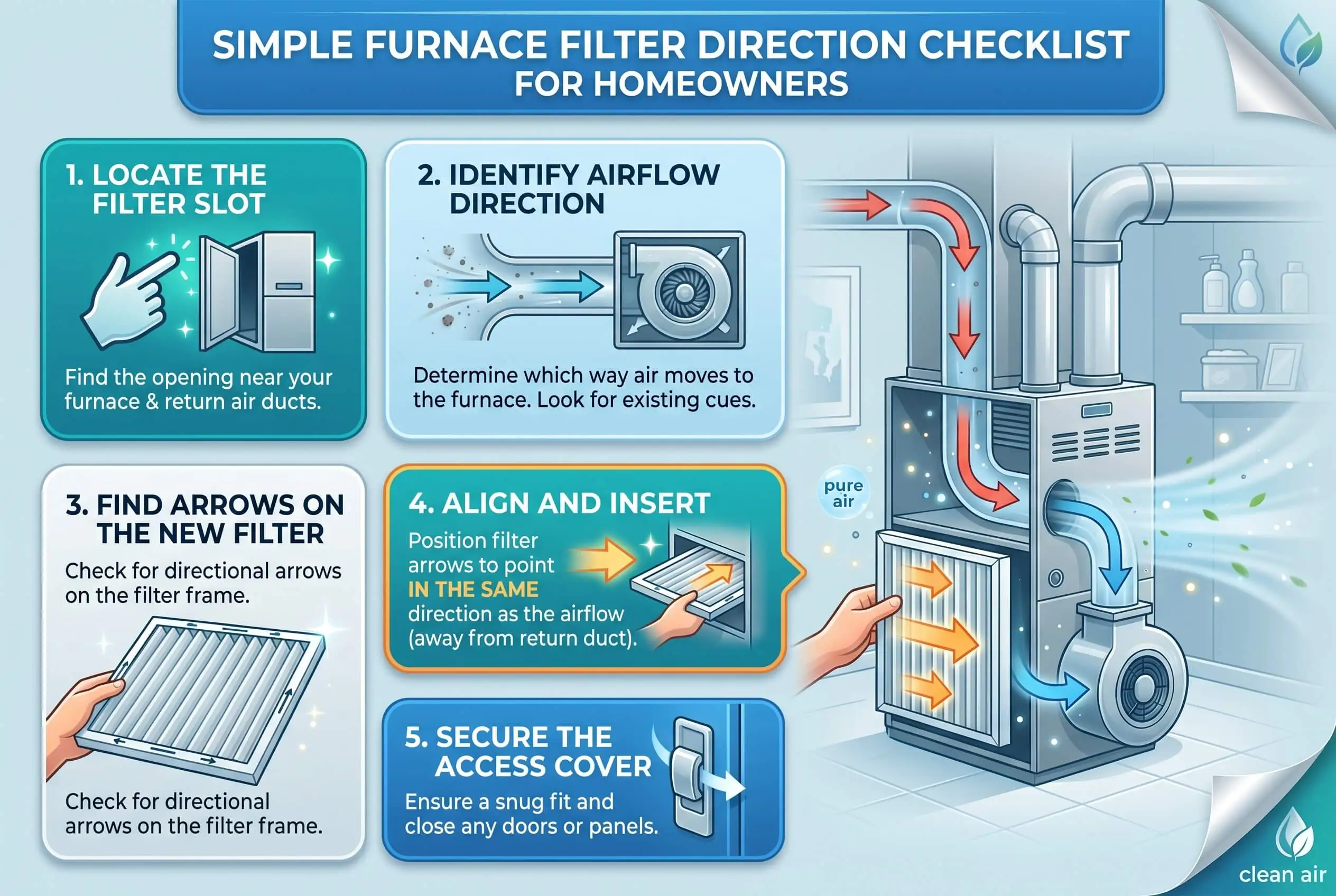
There is one rule that holds in every house we have ever serviced: the arrow on the filter frame points toward the blower motor. That is it. Return air pulls dust through the open weave of the filter, into the blower, and then out through your supply ducts. The arrow rides along with that flow.
On an upflow furnace down in the basement, the arrow points up. Downflow installations in the attic do the opposite, with the arrow pointing down toward the heat exchanger below. For a horizontal furnace in a crawl space or closet, the arrow runs sideways toward whichever end of the cabinet holds the blower. The cabinet orientation changes from house to house. The rule we just gave you does not.
If you want a step-by-step walkthrough with photos for every cabinet type, this furnace filter direction guide covers upflow, downflow, and horizontal setups in detail.
The Sixty-Second Pre-Install Checklist
Before sliding the new filter into the slot, run this sequence. Each step takes about ten seconds.
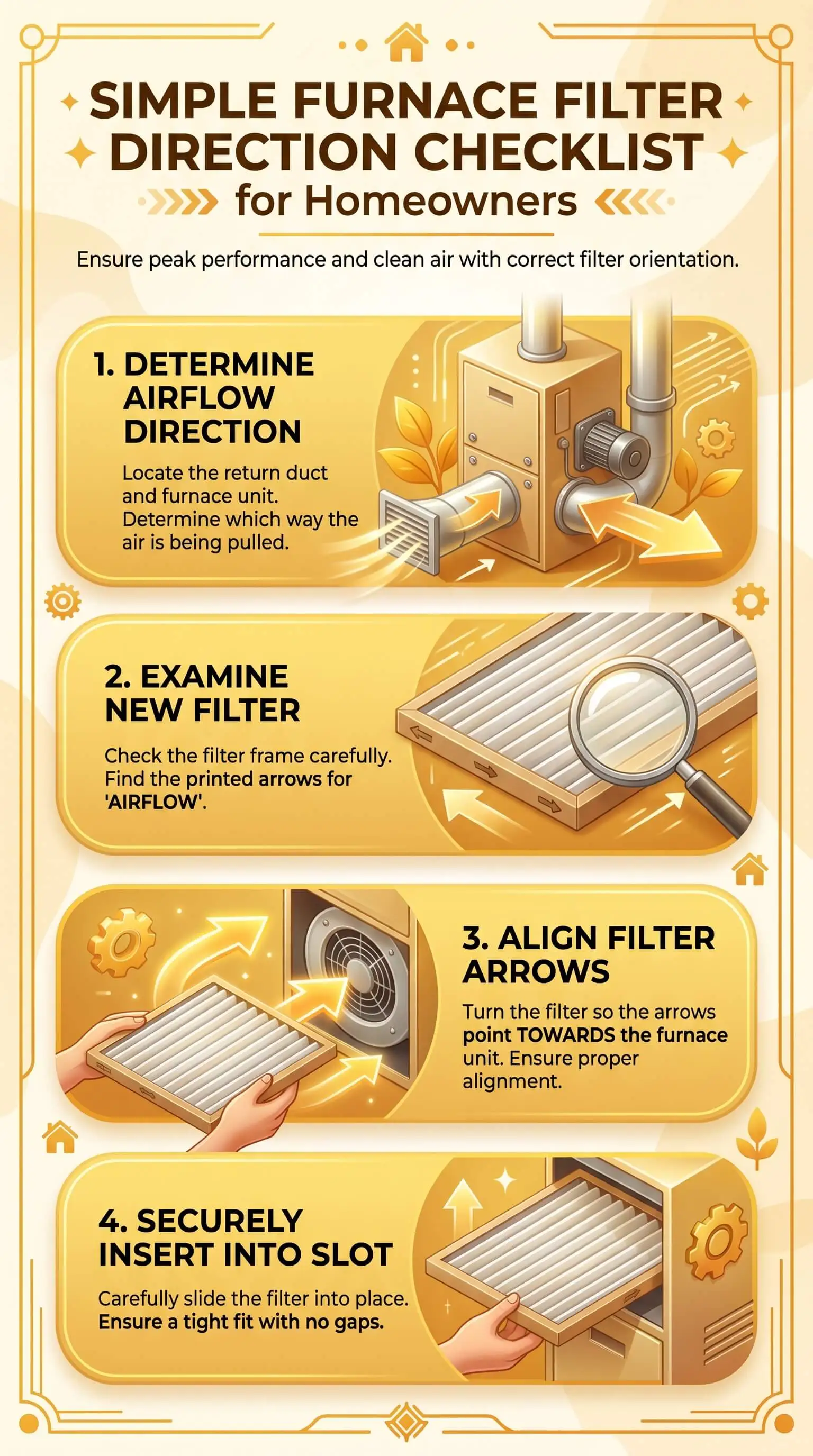
Find the arrow. It is printed on the side of the frame, sometimes faintly. We have had to turn a filter in our hands two or three times under a basement light before spotting it. Check all four edges and it will turn up.
Identify the blower side of the cabinet. That is the side with the big fan housing, usually behind a removable panel. The arrow on the filter points toward this side.
Confirm the filter size matches the slot exactly. Length × width × thickness should read the same as the old filter. A 16x25x1 slot needs a 16x25x1 filter. Close-enough leaves gaps, and air takes the path of least resistance straight around the filter.
Slide the filter in with the arrow leading toward the blower. The frame should sit flush against the back of the slot with no daylight along the edges.
Check that the cabinet door seals shut. A door that will not latch usually means the filter is too thick or it has been pushed past its stop point.
Write the install date on the filter frame with a permanent marker. Three months from now, you will know exactly when to swap it.
When the Filter Has No Arrow
Some basic fiberglass filters skip the airflow arrow entirely. In that case, the filter itself tells you which way it goes. You just have to know what to look at.
Air filters are built with a density gradient. The side that faces incoming air is looser and more open. The side that faces the blower is denser and tighter. Hold the filter on edge under a decent light and the difference shows plainly: one side has visibly more open fiber than the other.
If your filter has a wire mesh backing, that mesh sits on the blower side. The pleats run in the same direction the air does. When in doubt, put the wire backing toward the furnace and the open weave toward the return vent.
Signs the Filter Is Already in Backwards
Already closed the cabinet and not sure you got it right? Do not worry about it. The system will tell you within a day or two if the filter is reversed. We have walked into plenty of homes on routine calls and found the same handful of symptoms every time.
The filter bows visibly. Air pressure pushes the media against the wire backing instead of into it, so the pleats deform toward the cabinet door. You might also notice a louder rush at the return vent than usual, because the resistance has changed and the air is working harder to get through.
Dust shows up faster on supply registers, too. Particles that would normally catch in the open weave slip past the dense side instead and ride the airflow right back into your rooms. Two days after a backwards install, run a finger across the closest vent in your living room. The line of dust will be obvious.
The system also tends to short-cycle or run longer to hit your setpoint. Restricted airflow raises static pressure inside the ducts. On some furnaces, including electric furnaces, that can trip a safety limit. On all furnaces it forces the heat exchanger to work harder than it should.
“After fifteen years of service calls across Central Florida, I would put it at about one in six filters installed backwards when we get to a home for the first time. Homeowners hear the change in airflow at the return vent and assume something expensive has gone wrong. Usually they are bracing for a blower motor diagnosis. The fix takes thirty seconds when a top furnace filter is installed in the right direction. The damage from leaving the filter reversed for a full ninety-day cycle costs hundreds in efficiency loss, plus wear and tear we do not get back.”
7 Essential Resources
We pulled these directly from primary sources we trust and check often. Every link is live as of writing.
U.S. EPA, Guide to Air Cleaners in the Home. Consumer-focused guidance on portable air cleaners and HVAC filter selection. epa.gov/indoor-air-quality-iaq/guide-air-cleaners-home
U.S. EPA, Air Cleaners and Air Filters in the Home. Technical resources covering MERV ratings, particle filtration, and HVAC filter performance. epa.gov/indoor-air-quality-iaq/air-cleaners-and-air-filters-home
ENERGY STAR, Heat & Cool Efficiently. Filter change timing and HVAC maintenance guidance from the joint EPA and DOE program. energystar.gov/saveathome/heating-cooling
U.S. Department of Energy, Home Cooling Systems. Official guidance on maintaining residential cooling equipment, including filter care. energy.gov/energysaver/home-cooling-systems
U.S. Energy Information Administration, Use of Energy in Homes. Primary data on how heating and cooling fit into total household energy consumption. eia.gov/energyexplained/use-of-energy/homes.php
ASHRAE, Position Document on Filtration and Air Cleaning. Industry-standard reference on filter performance testing and MERV rating methodology. ashrae.org Position Document on Filtration and Air Cleaning
Asthma and Allergy Foundation of America, Healthier Home Indoor Air Quality. Filtration and indoor air quality guidance for households dealing with allergies or asthma. aafa.org/healthier-home-indoor-air-quality
Supporting Statistics
Americans spend roughly 90 percent of their time indoors, most of it inside their own homes. That means whatever is in your air filter, or slipping past it, is what your family breathes day in and day out. Source: U.S. EPA, Guide to Air Cleaners in the Home.
Heating and air conditioning together accounted for 52 percent of total annual energy consumption in U.S. homes in 2020, making it the single largest category of household energy use. A filter installed wrong throws sand in those gears for ninety days at a stretch. Source: U.S. Energy Information Administration, Use of Energy in Homes.
ENERGY STAR recommends checking your HVAC filter every month during heavy-use seasons and replacing it at least every three months. The reason is straightforward: a dirty filter slows airflow, and the system has to work harder to make up the difference. Source: ENERGY STAR, Heat & Cool Efficiently.
Final Thoughts and Opinion
Filter direction is the smallest detail in a furnace install and one of the easiest to get backwards. The single rule covers every cabinet we have ever worked on: the arrow points toward the blower motor. Take the sixty seconds to verify it before the door closes, and the system runs the way the engineers built it to for the full filter life, which can help keep furnace replacement on a smarter, more planned timeline. Our honest opinion, after enough service calls to lose count: never install a filter without first finding that arrow. The five seconds it takes is the cheapest insurance in HVAC.
Frequently Asked Questions
Which way does the arrow on a furnace filter point?
The arrow points toward the blower motor, riding along with the airflow through your system. Return air enters the open-weave side of the filter, passes through the media, and exits the dense side into the blower.
What happens if I install my furnace filter backwards?
Airflow drops, the system works harder to reach your setpoint, and dust slips past the filter into the ductwork. Over a full ninety-day cycle, a reversed filter also strains the blower motor and adds wear on the heat exchanger. We have seen perfectly fine systems get blamed for failures that were really just a backwards filter running for three months.
Does the direction matter on a pleated filter?
Yes. Pleated filters are built with a layered media design that has a density gradient. Air has to enter through the looser layer and exit through the denser one for the filter to work as rated. Reverse that flow, and you lose filtration efficiency and add static pressure across the filter face.
How do I know which side of a furnace filter faces out?
The open-weave side faces the return air, away from the furnace. The denser side, often backed by wire mesh, faces the blower. If there is an arrow on the frame, follow it toward the blower, no matter which side of the filter is visible from the room.
Can I run my furnace if the filter is installed wrong?
Yes, the system will run, just at reduced efficiency. Over time, restricted airflow can trip safety limits on some models and shorten your blower motor's lifespan on all of them. The fix is a thirty-second filter flip with no tools required.
How often should I check my furnace filter direction?
Every time you change the filter. ENERGY STAR recommends checking the filter monthly during heavy-use seasons and replacing it at minimum every three months. Make checking the arrow direction part of your routine, and you will catch installation errors before they cost you anything.
Make the Checklist Part of Every Filter Change
Make the arrow check part of every furnace filter replacement. It takes less time than ripping the plastic off a new filter, and your system will run the way it was designed to for the next ninety days.