This guide changes that. We'll show you exactly how to read your furnace's signals — from airflow and odor to cycling patterns and filter condition — so you can act before a dirty system becomes a costly repair.
TL;DR Quick Answers
how to clean a furnace
Cleaning a furnace takes less than two hours and should be done once a year before the heating season begins. Here is exactly what to do:
Turn off the power switch at the furnace and close the gas supply valve on gas-burning systems
Replace the air filter entirely — do not vacuum it in place
Vacuum the furnace cabinet exterior, surrounding area, and return air registers
Wipe down the exterior cabinet with a dry cloth
Clear all supply and return registers throughout the home
Schedule a licensed technician to clean the blower assembly, burner assembly, heat exchanger, flame sensor, and flue pipe
What homeowners can clean themselves:
Furnace cabinet exterior
Return air registers and surrounding ductwork access points
What requires a licensed technician:
Blower wheel and motor housing
Burner assembly and flame sensor
Heat exchanger inspection and cleaning
Flue pipe and carbon monoxide venting check
Call a professional immediately if you notice:
Burning smells that persist beyond the first two heating cycles
Yellow or orange burner flames
Short cycling after a filter replacement
Soot or carbon buildup around venting connections
Reduced airflow that doesn't improve after a new filter is installed
After manufacturing air filters for over a decade and working with more than two million households, the single most important furnace cleaning step we recommend is this: replace the filter before the first heating cycle of the season, and schedule a professional inspection the same day. Those two actions alone prevent the majority of furnace problems we see every winter.
Top Takeaways
Your furnace communicates before it fails. Weak airflow, short cycling, rising energy bills, persistent odors, and a clogged filter rarely appear alone. Acting on the first warning sign is always less expensive than waiting for the second or third.
A dirty furnace is an indoor air quality problem, not just a mechanical one. The EPA confirms indoor pollutant concentrations can run 2 to 5 times higher than outdoor levels. An overdue furnace actively contributes to that buildup on every heating cycle. Most homeowners don't connect their family's respiratory symptoms to their heating system until well after the problem has developed.
Carbon monoxide risk peaks during the months your furnace runs hardest. CDC data shows 36 percent of unintentional CO poisoning deaths occur in December, January, and February. Cleaning and inspecting before the heating season is the most important step you can take before those months arrive.
The real cost of a dirty furnace is what it charges you every month before it breaks. Reduced efficiency, higher utility bills, and accelerated component wear accumulate silently. Annual cleaning is the simplest way to break that cycle before it starts.
Three habits separate homeowners who maintain their furnace from those who react to it:
Replace the filter on schedule
Schedule a professional inspection before heating season
Pay attention to how the system sounds, smells, and performs
After working with more than two million households, we've found those three habits alone account for the difference between a furnace that lasts 20 years and one that struggles to reach 12.
Why a Dirty Furnace Is Easy to Miss
A furnace doesn't stop working the moment it needs cleaning. It keeps running — just less efficiently, less cleanly, and with more wear on the components that keep it reliable. In our experience working with millions of households, that slow decline is exactly what makes a dirty furnace so easy to overlook. By the time most homeowners notice a problem, the buildup has already been there for months.
Knowing the specific signs to watch for is what separates a quick cleaning appointment from a costly repair call.
Your Air Filter Is Clogged or Overloaded
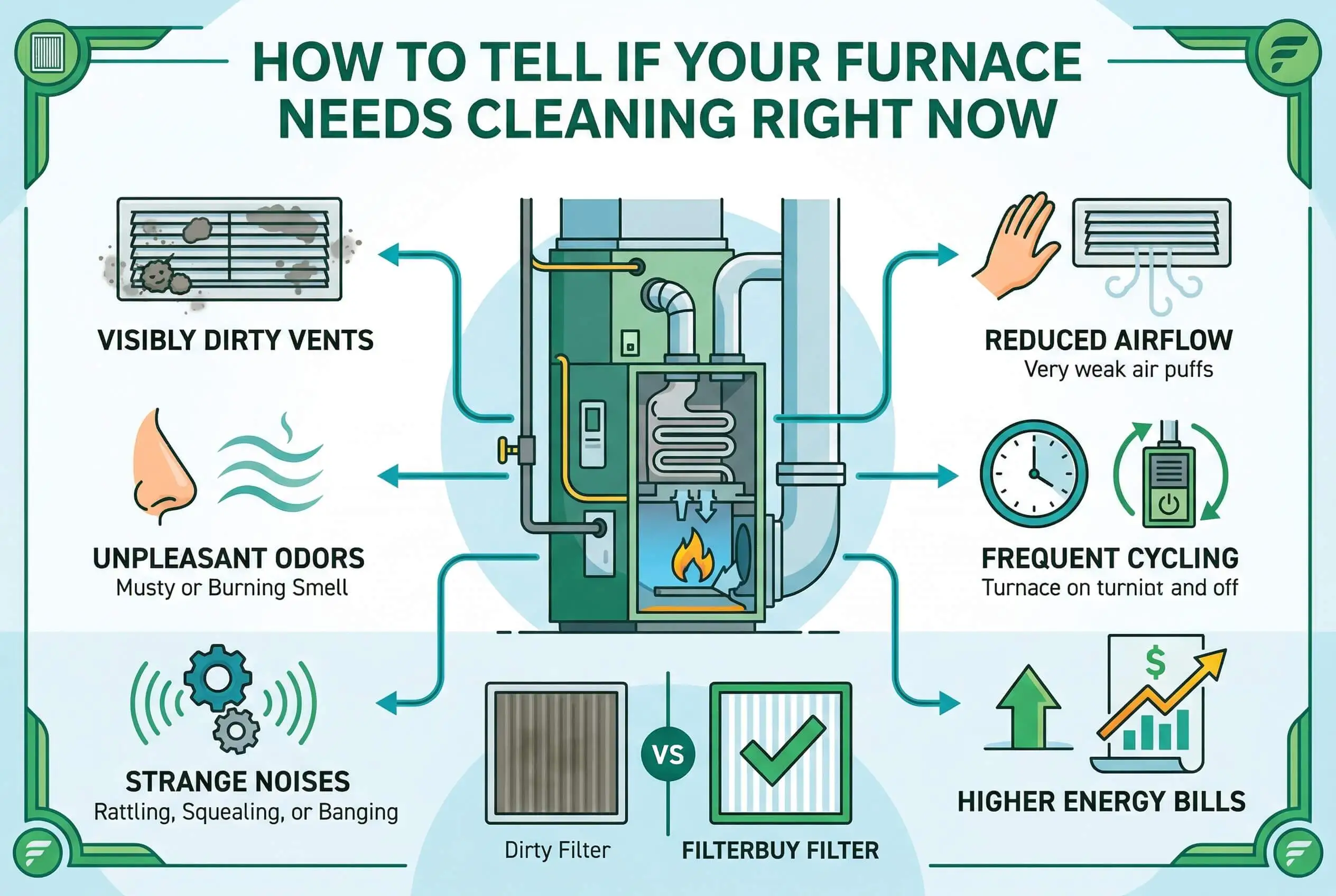
Your air filter is the first and most visible indicator that your furnace needs attention. When the filter is gray, matted, or visibly packed with debris, it's no longer doing its job — and your furnace is working significantly harder to pull air through it.
Check your filter right now. If you can't see light passing through it when held up to a light source, it's overdue for a change. If you're wondering how to change furnace filters, a clogged filter is also one of the leading causes of furnace overheating, which can trigger safety shutdowns and, over time, crack the heat exchanger — one of the most expensive furnace components to replace.
A general replacement schedule to follow:
1-inch filters: every 30–60 days
4-inch filters: every 6–12 months
Homes with pets or allergy sufferers: replace more frequently
Weak or Uneven Airflow Through Your Vents
When airflow feels weaker than it used to — or noticeably uneven from room to room — dust and debris buildup inside the furnace is often the cause. Over time, particle accumulation on the blower wheel, motor housing, and internal components restricts air movement throughout the entire system.
Walk through your home and hold your hand near each register. Significant differences in output between vents that were previously balanced point directly to a system that needs cleaning.
Unusual Odors When the Furnace Runs
A burning dust smell at the start of heating season is normal — that's residual dust burning off after months of inactivity. But if that smell persists beyond the first day or two, or returns mid-season, it's a sign that dust and debris have accumulated on internal components and are burning off continuously during every cycle.
A musty or stale odor is a separate concern. That often indicates mold or organic growth inside the system or ductwork — something that requires prompt attention, especially in households with asthma or allergy sufferers.
Short Cycling — Your Furnace Turns On and Off Too Frequently
Short cycling happens when a furnace heats up, shuts off before completing a full heating cycle, and then restarts shortly after. It's one of the clearest mechanical signals that something is wrong — and a dirty system is one of the most common causes.
When dust and grime coat the heat exchanger or block airflow around the burner assembly, the furnace overheats faster than its design allows. The built-in high-limit switch detects the excess heat and shuts the system down as a safety measure. The furnace cools, restarts, overheats again, and the cycle repeats.
Left unaddressed, short cycling dramatically accelerates wear on the system's most critical components.
Your Energy Bills Have Increased Without an Obvious Reason
A dirty furnace runs longer and works harder to deliver the same amount of heat. That additional strain shows up directly on your utility bill. If your heating costs have crept up over the past one or two billing cycles — without a corresponding change in temperature or usage habits — reduced furnace efficiency from buildup is one of the first things to investigate.
Visible Dust Around Vents and on Surfaces Near the System
When a furnace is overloaded with internal debris, it begins redistributing that material through your ductwork. If you're noticing increased dust accumulation on surfaces near floor registers, on furniture, or on walls adjacent to vents, your furnace is no longer filtering and circulating air effectively.
This is the "make the invisible visible" moment we talk about at Filterbuy. The dust you can see on your shelves and registers is a direct reflection of what's circulating through your air — and through your family's lungs.
What to Do If You Recognize These Signs
Catching these warning signs early puts you in control. Depending on what you find, the next steps typically fall into one of two categories.
DIY actions you can handle right now:
Replace a clogged or overloaded air filter
Vacuum accessible areas around the furnace cabinet and return air vents
Check and clear any obstructions at supply and return registers
Inspect the area around the furnace for visible dust accumulation or debris
When to call a professional:
Persistent burning or musty odors after filter replacement
Ongoing short cycling that doesn't resolve with a new filter
Visible buildup on the burner assembly or blower wheel
Any concerns about the heat exchanger, gas lines, or internal components
A professional furnace cleaning typically includes a full inspection of the heat exchanger, burner assembly, blower motor, and drainage components — areas that are difficult or unsafe to access without proper training and equipment — while MERV 11 filters help support cleaner airflow, improved filtration, and better overall furnace performance.
"One thing we see consistently across millions of households is that homeowners wait too long because the early signs of a dirty furnace feel minor — a little extra dust, a slightly higher energy bill, a smell that fades after a day or two. But those aren't minor signals. They're your system telling you it's already working harder than it should. After over a decade of manufacturing air filtration products and working directly with HVAC systems across the country, we've learned that the furnaces that last the longest aren't the most expensive ones — they're the ones whose owners paid attention early. A clogged filter or a layer of dust on the blower wheel might seem insignificant, but left alone, those small issues compound into heat exchanger stress, short cycling, and repair bills that dwarf the cost of a simple cleaning. The homeowners who treat these early warnings seriously are the ones who rarely face emergency breakdowns."
Essential Resources
Your furnace is one of the most expensive systems in your home — and one of the most overlooked until something goes wrong. After manufacturing air filters for over a decade and working with more than two million households, we know that the homeowners who stay ahead of furnace problems are the ones who use the right information before they need it. These seven resources cover everything from step-by-step cleaning to carbon monoxide safety, so you can protect your system, your energy bills, and your family's air.
1. Your Complete Step-by-Step Furnace Cleaning Guide
Most furnace cleaning guides skim over the components that matter most. Our guide at Filterbuy goes deeper — walking you through the blower assembly, heat exchanger, flame sensor, and air filter with the kind of practical detail that comes from working on HVAC systems across millions of homes. You'll also find clear guidance on when DIY maintenance makes sense and when a professional should take over.
2. How Furnace Efficiency and Maintenance Affect Your Energy Bills
A dirty furnace doesn't just affect your air — it quietly inflates your energy bills every month it goes uncleaned. The U.S. Department of Energy outlines how combustion efficiency testing, heat exchanger cleaning, and duct sealing directly reduce fuel consumption and heating costs. If your bills have been climbing without an obvious explanation, this is where to start.
Source: U.S. Department of Energy — https://www.energy.gov/energysaver/furnaces-and-boilers
3. What Every Homeowner Needs to Know About Furnace Carbon Monoxide Risk
Gas- and oil-burning furnaces produce carbon monoxide — an odorless, invisible gas that poses a serious health risk when a furnace is poorly maintained. This is the hidden danger most homeowners don't think about until it's too late. The CDC's furnace safety fact sheet covers the specific CO risks tied to furnace operation and the prevention steps every household should have in place before the heating season begins.
Source: U.S. Centers for Disease Control and Prevention — https://www.cdc.gov/carbon-monoxide/factsheets/furnace-safety-fact-sheet.html
4. When Your Ducts Need Cleaning — and When They Don't
Duct cleaning is one of the most misunderstood parts of furnace maintenance, and in our experience, it's one of the areas where homeowners most often get conflicting advice. The EPA cuts through the confusion — clarifying exactly when duct cleaning is warranted, what a proper cleaning involves, and why your furnace should be inspected and serviced before every heating season regardless of duct condition.
Source: U.S. Environmental Protection Agency — https://www.epa.gov/indoor-air-quality-iaq/should-you-have-air-ducts-your-home-cleaned
5. How to Inspect Your Furnace for Carbon Monoxide and Combustion Hazards
Before you clean any part of your furnace, you need to know what safe operation actually looks like. This U.S. Department of Energy technical brief covers the inspection and testing procedures used to identify fuel leaks, carbon monoxide hazards, and fire risks in furnaces and combustion appliances. It's the kind of foundational safety knowledge that belongs in every homeowner's toolkit.
Source: U.S. Department of Energy — https://www.energy.gov/sites/prod/files/2016/06/f32/CombustionAppliance%20Safety_Tech%20Brief.pdf
6. The Annual Furnace Maintenance Checklist Trusted by Homeowners for Decades
We always recommend that homeowners understand what a full annual maintenance cycle actually looks like — not just the filter swap, but the combustion chamber, flue pipe, blower, and beyond. This Old House covers the complete fall and winter maintenance process in a format that's been trusted by homeowners for decades. It's one of the most thorough consumer-facing walkthroughs available outside of a professional service call.
Source: This Old House — https://www.thisoldhouse.com/heating-cooling/21016379/furnace-maintenance
7. What a Professional Furnace Cleaning Actually Includes
One of the most common questions we hear from homeowners is: how do I know if a professional cleaning was done right? Carrier's 9-step breakdown answers that question directly — covering every component a certified HVAC technician inspects and cleans, from the blower assembly and flame sensor to the heat exchanger and filter system. If you're scheduling a professional cleaning or comparing it to DIY, this is the benchmark to reference.
Source: Carrier — https://www.carrier.com/residential/en/us/products/furnaces/furnace-service/furnace-cleaning/
Supporting Statistics
After over a decade of manufacturing air filters and working with more than two million households, we've learned that the biggest threats to your family's air and your furnace's performance are almost always invisible, cumulative, and preventable. The EPA, CDC, and U.S. Department of Energy data below reflects what we see playing out in homes across the country every heating season.
The air inside your home is likely more polluted than the air outside your front door.
That number consistently surprises the homeowners we work with — and it reframes what furnace cleaning actually means.
According to the U.S. Environmental Protection Agency:
Americans spend approximately 90 percent of their time indoors
Indoor pollutant concentrations often run 2 to 5 times higher than typical outdoor levels
Those most vulnerable — children, elderly adults, and people with respiratory conditions — tend to spend even more time indoors
When a furnace is overdue for service, it stops filtering air effectively. It starts redistributing dust, debris, allergens, and combustion byproducts through every room on every heating cycle, which is why using top air filters matters. A clean, well-maintained furnace directly reduces that daily exposure.
Source: U.S. Environmental Protection Agency — https://www.epa.gov/report-environment/indoor-air-quality
Carbon monoxide risk doesn't peak when your furnace is idle — it peaks when it's running constantly.
One pattern we see every year is homeowners delaying furnace cleaning until after the heating season ends. The CDC data shows exactly why that timing is a problem.
According to the CDC National Vital Statistics System:
36 percent of unintentional CO poisoning deaths in 2015 occurred in December, January, or February
Unintentional CO exposure accounts for an estimated 15,000 emergency department visits annually
Approximately 500 unintentional CO deaths occur in the United States every year
Gas- and oil-burning furnaces run hardest during winter. A furnace that hasn't been cleaned or inspected before heating season is one of the most common and most preventable contributors to that risk. Scheduling inspection before first seasonal use isn't overcautious — it's the standard we've always recommended.
Sources: CDC MMWR — https://www.cdc.gov/mmwr/volumes/66/wr/mm6608a9.htm CDC Carbon Monoxide Deaths Report — https://www.cdc.gov/mmwr/preview/mmwrhtml/mm5650a1.htm
Every month a dirty furnace runs uncleaned, it costs more to operate than it should.
In our experience, homeowners attribute rising energy bills to rate increases or colder weather long before they consider their furnace. The U.S. Department of Energy puts the efficiency gap in concrete terms:
Upgrading from 56 percent to 90 percent furnace efficiency saves 1.5 tons of CO2 annually in an average cold-climate home
Energy efficiency improvements can often cut fuel bills in half
Duct heat losses alone can account for as much as 35 percent of furnace energy output
Maintenance protects that efficiency over time. Dust and debris on the heat exchanger, blower, and burner assembly quietly push a furnace below its designed capacity — adding cost to every billing cycle with no visible sign of the problem. Annual cleaning is the simplest way to break that pattern.
Source: U.S. Department of Energy — https://www.energy.gov/energysaver/furnaces-and-boilers
Final Thoughts
Most furnace problems don't start with a breakdown. They start with small, overlooked maintenance steps that compound quietly over months until the system can no longer hide the damage. After working with more than two million households, that's the pattern we see more consistently than any other.
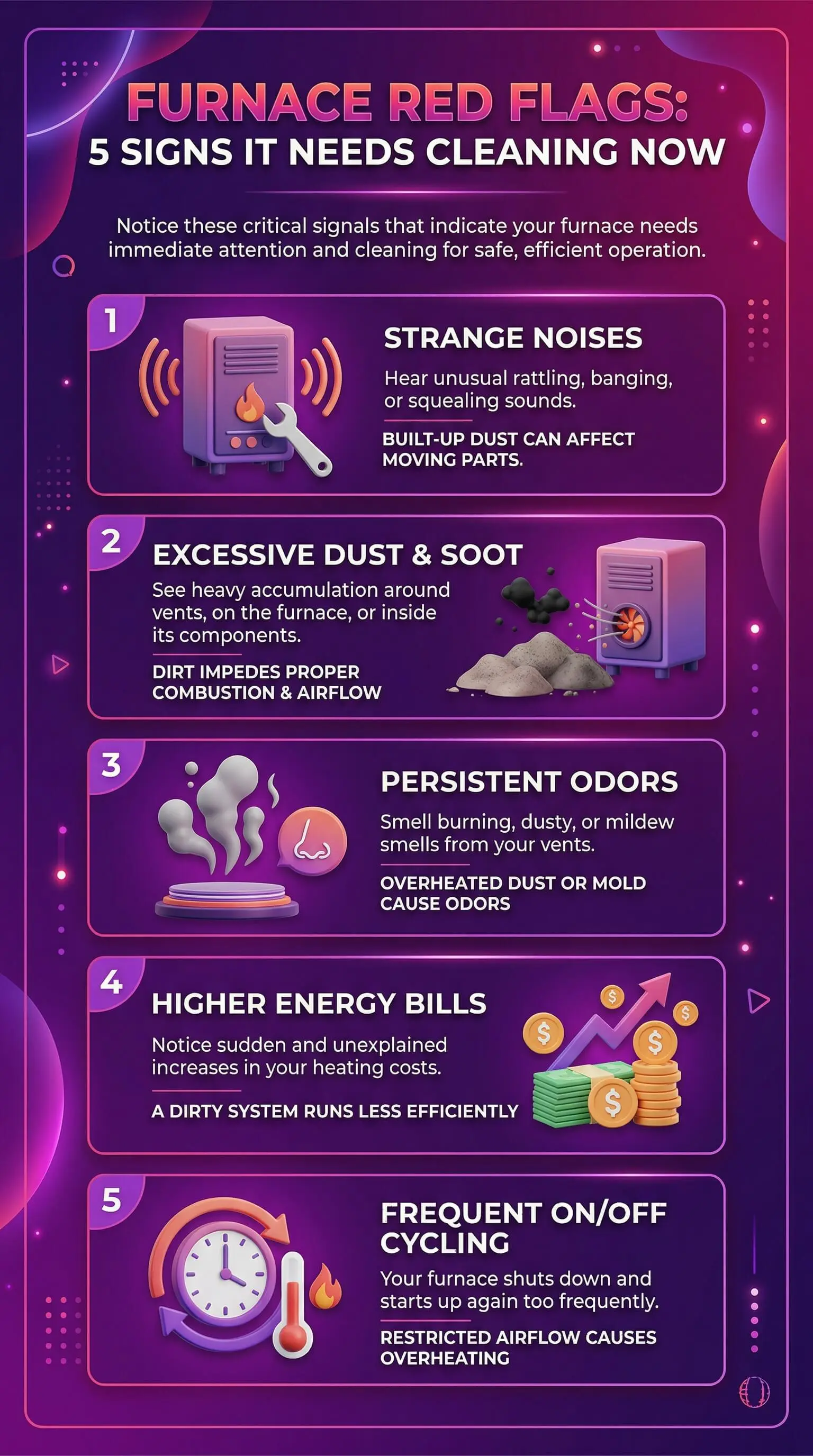
The warning signs in this guide aren't worst-case scenarios — they're the early signals your furnace is already sending. And they rarely travel alone. When one appears, look for the others:
Weak or uneven airflow
Short cycling and frequent restarts
Rising energy bills without an obvious cause
Persistent burning or musty odors
A clogged or overloaded air filter
These aren't independent problems. They're the same problem showing up in different places at the same time.
Where our perspective differs from most furnace maintenance advice:
The conversation around furnace cleaning tends to center on cost — how much a professional cleaning runs, whether it's worth it, whether it can wait. In our experience, that framing gets it backwards. The real cost question isn't what a cleaning costs. It's what delayed cleaning costs over time:
Reduced system efficiency on every heating cycle
Accelerated wear on the blower, heat exchanger, and burner assembly
Higher utility bills with no visible explanation
Degraded air circulating through a home where your family spends 90 percent of their time
A furnace that runs clean doesn't just heat more efficiently. It filters more effectively, cycles less frequently, and lasts significantly longer.
The homeowners who act on early warning signs — who replace filters on schedule, choose the right furnace filter sizes, inspect before heating season, and pay attention to how their system sounds, smells, and performs — are the ones who rarely face emergency repairs. That isn't a coincidence. It's the difference between maintaining a system and reacting to one.
FAQ on How to Clean a Furnace
Q: How often should I clean my furnace?
A: Once a year — in late summer or early fall, before the heating season begins. In our experience, annual is a starting point, not a universal answer.
Your filter is the most reliable indicator:
Homes with pets or allergy sufferers load filters faster than the calendar accounts for
Gas furnaces accumulate combustion byproducts that electric systems don't produce
A filter that's gray, matted, and blocking light before its replacement date means your furnace is already working harder than it should
When the filter tells you it's time, don't wait for the calendar to catch up.
Q: What parts of the furnace actually need to be cleaned?
A: More than most homeowners expect. After serving over two million households, the blower wheel and heat exchanger are the two components we see most consistently neglected — and most responsible for short cycling, rising energy bills, and airflow problems.
A complete furnace cleaning covers:
Air filter — replace entirely, never clean in place
Blower wheel and motor housing — dust buildup directly chokes airflow
Burner assembly — carbon and debris affect combustion efficiency
Heat exchanger — inspect for cracks and corrosion alongside cleaning
Flame sensor — gritty buildup triggers unnecessary shutdowns
Flue pipe and venting — blockages create direct carbon monoxide risk
Filter replacement and exterior cleaning are DIY-appropriate. Everything from the blower assembly inward belongs with a licensed technician.
Q: Can I clean my furnace myself or do I need a professional?
A: Both — and knowing where that line falls is what separates a safe cleaning from one that creates new problems.
Handle these yourself:
Replace or clean the air filter on schedule
Vacuum around the furnace cabinet and return air registers
Clear supply and return registers throughout the home
Wipe down the exterior cabinet and remove surrounding debris
Leave these to a licensed technician:
Blower assembly and motor housing cleaning
Heat exchanger inspection and cleaning
Burner assembly and flame sensor servicing
Flue pipe and venting inspection for carbon monoxide risk
Homeowners who handle accessible tasks consistently between annual professional visits get significantly more life out of their systems than those who wait for something to go wrong.
Q: What is the most common mistake homeowners make when cleaning their furnace?
A: Starting before the power and gas are off. Every furnace cleaning — including a basic filter swap — should begin with:
Power switch turned off at the furnace
Gas supply valve closed for gas-burning systems
Confirmation that only the person who shut off utilities turns them back on
Two additional mistakes we see consistently:
Vacuuming around a loaded filter instead of replacing it. A heavily loaded filter redistributes debris when disturbed. It needs to come out entirely.
Using household cleaners or water on internal components. Interior furnace surfaces require dry cleaning only — soft brushes, dry cloths, and vacuum attachments. Moisture on electrical components or the heat exchanger causes corrosion that often isn't visible until it becomes a serious problem.
Q: How do I know if my furnace needs a professional cleaning rather than a DIY cleaning?
A: Stop and call a licensed technician before attempting to clean the system yourself if any of the following are present:
A burning smell that persists beyond the first one or two heating cycles
Visible soot or carbon buildup around the burner assembly or venting
Yellow or orange burner flames instead of a consistent blue flame
Short cycling that continues after a filter replacement
Corrosion, cracks, or discoloration on or near the heat exchanger
Reduced airflow that doesn't improve after a fresh filter is installed
These aren't cleaning problems — they're diagnostic ones. In our experience, cleaning a furnace showing these signs without a professional inspection first can mask symptoms that need to be identified before the system runs another heating cycle.
A licensed technician will:
Test for carbon monoxide leakage
Assess heat exchanger integrity
Service components that are unsafe to access without proper equipment
Ready to Clean Your Furnace and Protect Your Home's Air?
Now that you know exactly what to look for, don't let a dirty furnace quietly drain your system's efficiency, drive up your energy bills, and circulate degraded air through your home for another season. Shop Filterbuy's air filters or schedule a professional furnace cleaning with Filterbuy HVAC Solutions today — and give your furnace what it needs to protect your family all winter long.