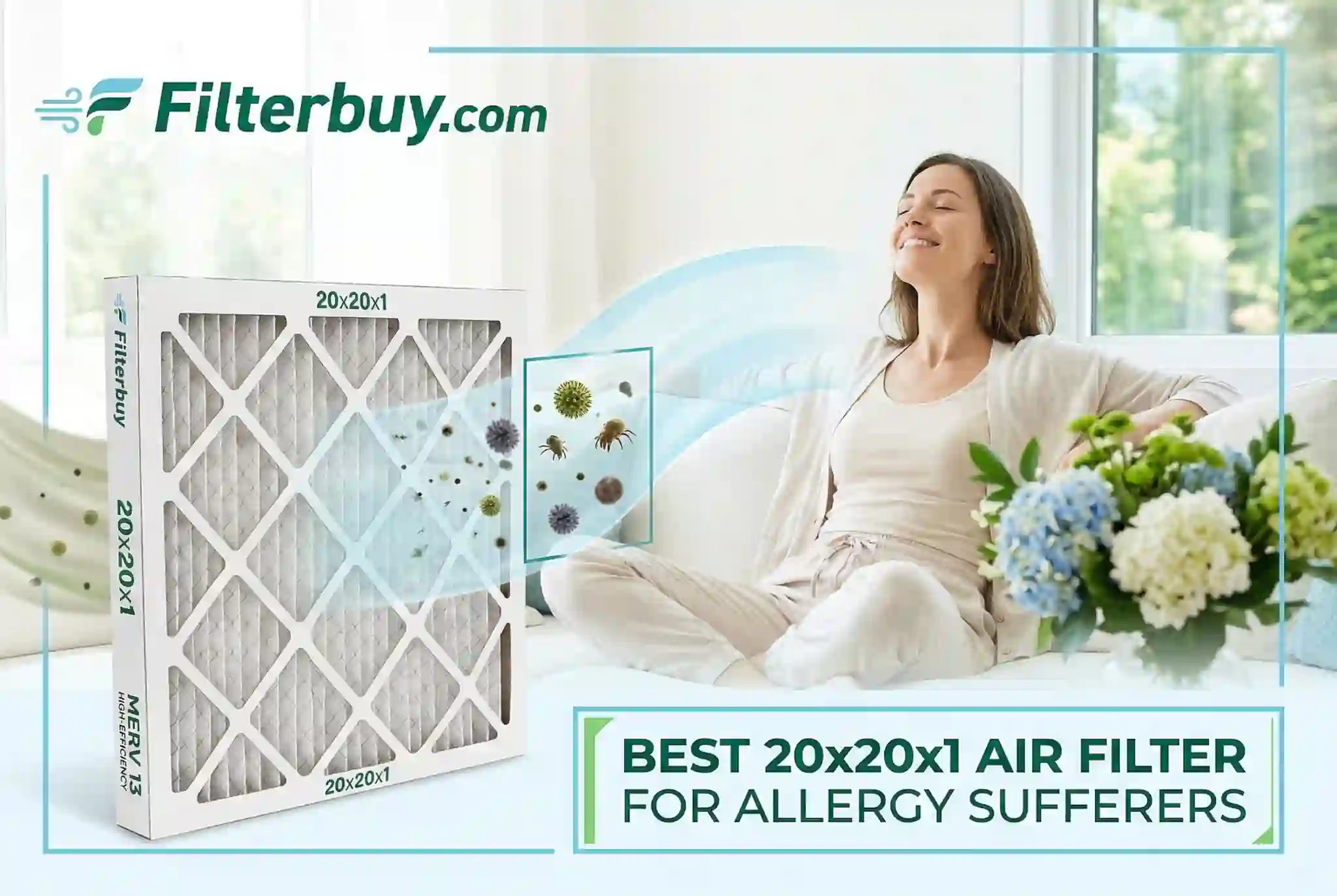
This guide breaks down the best 20x20x1 air filter for allergy relief — what to look for in a MERV rating, which airborne triggers your filter should be catching, and how to choose the right option for your home and HVAC system. Whether you're dealing with pollen, pet dander, dust mites, or mold spores, the right 20x20x1 filter can make a measurable difference in how you feel inside your own home.
TL;DR Quick Answers
20x20x1 Air Filter
A 20x20x1 air filter is one of the most common residential HVAC filter sizes in the United States. Here's what every homeowner needs to know:
Actual size: 19½" x 19½" x ¾" — not the nominal dimensions printed on the frame
Available MERV ratings: MERV 8 (standard), MERV 11 (allergy relief), MERV 13 (severe allergies and asthma)
Best for allergy sufferers: MERV 11 for most households; MERV 13 for severe allergies or asthma — if your HVAC system supports it
Replacement schedule: Every 20 to 60 days for allergy households depending on pets, symptom severity, and seasonal conditions
Most important fit factor: A proper seal with no bypass gaps — a poorly fitted filter lets allergens flow around the media regardless of MERV rating
After manufacturing millions of 20x20x1 filters and serving more than two million households, the single most consistent finding is this: the right rating, a proper fit, and a timely replacement schedule — working together — deliver more allergy relief than any one factor alone.
Top Takeaways
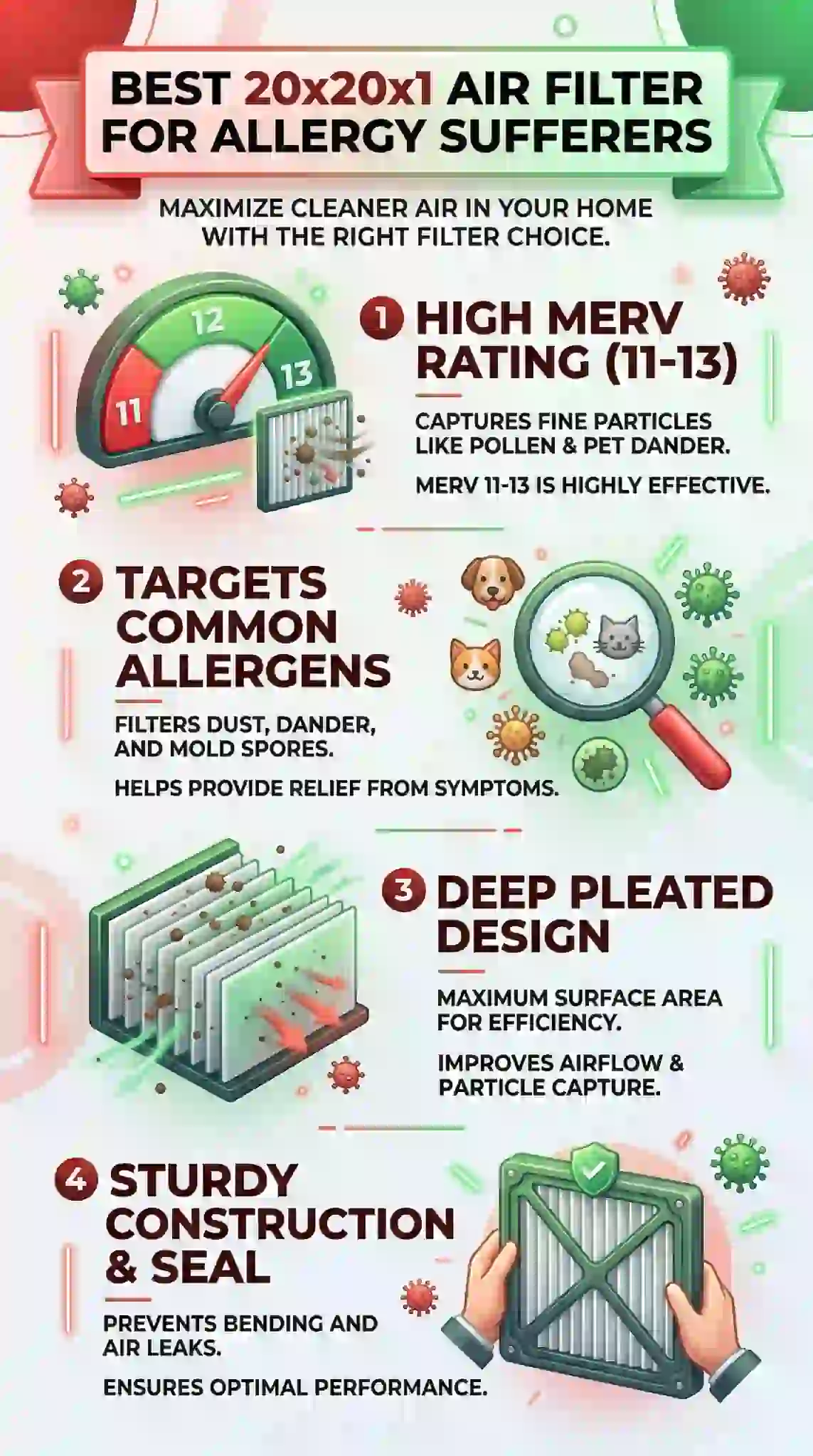
MERV rating is the most important spec — but it's only part of the equation. MERV 11 suits most allergy households. MERV 13 is right for severe allergies, asthma, or multiple pets — only if your HVAC system can handle it.
A high MERV rating means nothing if your filter doesn't fit. Nominal and actual dimensions are not the same number. Bypass gaps let allergens flow around the filter media entirely — regardless of the rating on the box.
An overloaded filter can actively work against you. Replace every 20 to 45 days based on your household conditions. A saturated filter doesn't just stop capturing allergens — it can release trapped particles back into your airstream.
Indoor air is almost always the bigger allergy threat. The EPA confirms indoor pollutant concentrations can run 2 to 5 times higher than outdoor levels. Your 20x20x1 filter works every hour your HVAC runs — not just during allergy season.
Three things working together determine real allergy relief:
The correct MERV rating for your household
A proper fit with no bypass gaps
A replacement schedule matched to your allergy load
After manufacturing millions of filters and serving more than two million households, that combination is the most consistent finding we've observed — every time.
Why MERV Rating Is the Most Important Factor for Allergy Sufferers
Not all 20x20x1 filters are built to capture the particles that trigger allergy symptoms. The single most important number on the box is the MERV rating — Minimum Efficiency Reporting Value — which measures how effectively a filter captures particles across a range of sizes.
From our manufacturing experience, here's how each rating tier performs for allergy sufferers:
MERV 8 — Captures larger particles like lint, dust, and pollen. Adequate for mild seasonal allergies in low-sensitivity households.
MERV 11 — Captures finer particles including mold spores, pet dander, and fine dust. The most practical upgrade for most allergy sufferers without restricting airflow.
MERV 13 — Captures ultrafine particles including bacteria, smoke, and microscopic allergens. Best for severe allergy sufferers, households with multiple pets, or anyone with respiratory sensitivities.
After manufacturing millions of filters across these ratings, we consistently find that MERV 11 is the sweet spot for most allergy households — high enough filtration to make a meaningful difference, without the static pressure concerns a MERV 13 can create in older or lower-powered HVAC systems.
What Allergens Does a 20x20x1 Filter Actually Capture?
The 20x20x1 size is widely used in residential HVAC systems, which means it's working around the clock to intercept the allergens circulating through your home. The most common triggers we see our allergy-sensitive customers targeting include:
Pollen — Tree, grass, and ragweed pollen is effectively captured at MERV 8 and above.
Pet dander — Microscopic dander particles require a MERV 11 or higher for consistent capture.
Dust mite debris — Technically the waste particles, not the mites themselves, which are tiny enough to need MERV 11+ to capture reliably.
Mold spores — Require MERV 11 at minimum; homes in humid climates should prioritize this trigger specifically.
Smoke and fine particulates — MERV 13 is recommended for households affected by wildfire smoke or indoor tobacco smoke.
The critical insight most filter guides miss: it's not just what a filter captures, but how consistently it captures it throughout its full service life. A filter's efficiency degrades as it loads with debris — which is why we engineer our media to maintain performance across the full replacement cycle, not just on day one.
MERV 11 vs. MERV 13 — Which Is Right for Your Allergies?
This is the question we hear most from allergy sufferers, and the honest answer depends on two factors: the severity of your symptoms and the capacity of your HVAC system.
Choose MERV 11 if you:
Have mild to moderate seasonal allergies
Own pets but don't have severe dander sensitivity
Have an older HVAC system or a system with a standard single-speed blower
Choose MERV 13 if you:
Suffer from severe or year-round allergies
Have multiple pets or a household member with asthma
Have a newer HVAC system rated for higher-efficiency filtration
Live in an area with high wildfire smoke or elevated outdoor air pollution
One thing we always flag: running a MERV 13 in an HVAC system not designed for it can restrict airflow, reduce system efficiency, and actually shorten the life of your equipment. When in doubt, check your system's manufacturer specifications before stepping up to a higher rating.
How Often Should Allergy Sufferers Change Their 20x20x1 Filter?
Standard guidance suggests replacing a 1-inch filter every 30 to 90 days, but for allergy sufferers, the lower end of that range is almost always the right call. A filter that's overloaded with captured allergens can't perform — and in some cases, a heavily loaded filter can begin to release trapped particles back into your airstream.
In our experience, allergy households should follow this replacement schedule:
Single occupant, no pets, mild allergies — Every 60 days
Multiple occupants or one pet, moderate allergies — Every 30 to 45 days
Multiple pets or severe allergies — Every 20 to 30 days
High pollen season or wildfire smoke events — Check and replace more frequently, regardless of baseline schedule
A simple visual check tells the story quickly: if the filter face is visibly gray and loaded with debris, it's past time for a replacement regardless of when you last changed it.
What to Look for Beyond MERV Rating
MERV rating is the most important factor, but it's not the only one. When evaluating 20x20x1 filters for allergy relief, also consider:
Filter media material — Electrostatically charged synthetic media attracts and holds fine particles more effectively than standard fiberglass. This is a meaningful difference for allergen capture.
Exact dimensions — A 20x20x1 filter has a nominal size of 20x20x1 but an actual size closer to 19.75x19.75x0.75 inches. A poor fit creates bypass gaps where unfiltered air — and allergens — pass around the filter entirely. That gap defeats the purpose of upgrading to a higher MERV rating in the first place.
Frame integrity — Cardboard frames that warp in humid conditions can create the same bypass problem. A reinforced beverage board or moisture-resistant frame holds its shape across a full replacement cycle.
American manufacturing — Filters manufactured domestically under consistent quality controls produce more predictable, reliable performance than imports with less oversight of media density and fiber distribution.
"Most allergy sufferers focus on finding the highest MERV rating available, but that's only half the equation. After manufacturing millions of 20x20x1 filters, we've learned that fit is just as critical as filtration efficiency. A MERV 13 filter with even a small bypass gap around the frame delivers worse real-world performance than a properly seated MERV 11 — because unfiltered air doesn't negotiate. It finds the path of least resistance every single time. The best filter for allergy relief isn't just the one with the right rating — it's the one that fits correctly, holds its shape across the full replacement cycle, and gets changed on schedule."
Essential Resources
Don't take your indoor air for granted. After manufacturing 20x20x1 filters for over a decade and shipping to more than two million households, we know the questions allergy sufferers ask most — and the answers that actually make a difference. These resources give you the manufacturer's perspective on everything you need to make a confident, informed decision.
1. The MERV Rating Explained — Because the Number on the Box Is Everything
Most homeowners pick a filter based on price or brand recognition. We've learned from experience that MERV rating is the single specification that determines whether a filter protects your family or simply looks like it does. The EPA's official MERV guide is where every allergy sufferer's filter research should start. https://www.epa.gov/indoor-air-quality-iaq/what-merv-rating
2. How Your HVAC Filter and Your Family's Health Are More Connected Than You Think
The EPA's guide to air cleaners in the home makes the invisible visible — revealing how airborne pollutants move through your home and how a properly selected HVAC filter intercepts them before your family breathes them in. Essential reading for any Prudent Protector serious about indoor air quality. https://www.epa.gov/indoor-air-quality-iaq/guide-air-cleaners-home
3. Know Your Enemy — The Indoor Allergens Your 20x20x1 Filter Is Up Against
You can't protect your family from threats you can't see. This National Institutes of Health clinical reference identifies the major indoor allergens found in U.S. homes — dust mites, pet dander, mold spores, pollen, and more — and documents exactly how each one triggers the symptoms your household is experiencing. https://www.ncbi.nlm.nih.gov/books/NBK236018/
4. Before You Upgrade Your MERV Rating, Make Sure Your System Can Handle It
We always tell our customers: the best filter is the highest-rated one your HVAC system is actually designed to run. This U.S. Department of Energy guide covers the MERV minimums required by ENERGY STAR and EPA's Indoor airPLUS program, plus the static pressure and airflow compatibility factors that determine how far you can safely upgrade. https://basc.pnnl.gov/resource-guides/high-merv-filters
5. MERV 8, 11, or 13 — Here's How to Choose the Right One for Your Allergy Situation
Not every allergy household needs the same filter. In our experience manufacturing across all three MERV tiers, the right rating depends on symptom severity, pet ownership, HVAC system age, and local air quality conditions. This guide walks you through the decision the same way we'd explain it from the production floor. https://filterbuy.com/resources/air-filter-basics/which-merv-rating-should-I-use/
6. Your 20x20x1 Filter's Actual Size Isn't 20x20x1 — Here's What That Means for You
One of the most common mistakes we see costs allergy sufferers real results: ordering a filter by nominal size without understanding the actual dimensions. A 20x20x1 filter measures closer to 19½" x 19½" x ¾" — and getting the fit wrong creates bypass gaps that let allergens flow right around the filter media. This guide makes sizing simple. https://filterbuy.com/resources/air-filter-basics/measure-air-filter/
7. A High MERV Rating Means Nothing If Your Filter Has a Bypass Gap
After serving more than two million households, we know this truth better than anyone: a MERV 13 filter with even a small gap around its frame delivers worse real-world performance than a properly seated MERV 11. This guide identifies the three most common causes of filter bypass — and shows you exactly how to eliminate each one at installation. https://filterbuy.com/resources/how-to-guides-and-hvac-maintenance/air-filter-fit-guide/
Supporting Statistics
After manufacturing air filters for over a decade and shipping to more than two million households, we've learned one truth that surprises most allergy sufferers: the air inside your home is almost always the bigger problem. The research confirms what we see in our customers' experiences every day.
Stat 1: Americans spend approximately 90% of their time indoors — where pollutant concentrations can run 2 to 5 times higher than outdoor levels.
The U.S. Environmental Protection Agency confirms indoor pollutant concentrations frequently exceed outdoor levels. What that means for allergy households:
Your indoor air is often more dangerous than the air outside
Your 20x20x1 filter is the most active line of defense in your home
It works every hour your HVAC system runs — not just during allergy season
Source: U.S. Environmental Protection Agency — Indoor Air Quality https://www.epa.gov/report-environment/indoor-air-quality
Stat 2: Nearly 1 in 3 U.S. adults and nearly 3 in 10 children have at least one diagnosed allergic condition.
The CDC's National Center for Health Statistics reports:
31.7% of U.S. adults have a diagnosed allergic condition
29.5% of U.S. children have a diagnosed allergic condition
Seasonal allergies alone affect 25.2% of adults
What those numbers don't capture is what we observe on our end. Allergy households using a gas furnace replace filters more frequently, notice symptom changes more acutely after a filter swap, and are the most likely to feel the difference between a MERV 8 and a MERV 11. Proper filter selection produces a measurable, felt result in these homes.
Source: CDC National Center for Health Statistics — FastStats: Allergies and Hay Fever https://www.cdc.gov/nchs/fastats/allergies.htm
Stat 3: 26.8 million Americans currently have asthma — and indoor allergens are among its most common triggers.
The American Lung Association reports 26.8 million Americans — 8.2% of the population — currently have asthma. Documented indoor triggers include:
Dust mites
Pet dander
Mold spores
From our manufacturing perspective, this statistic carries specific weight. Asthma households don't have the luxury of a suboptimal filter, which is why furnace filters play such a critical role. A properly sealed MERV 13 in a 20x20x1 housing, changed on schedule, delivers one critical advantage no other home intervention can match: it works continuously, 24 hours a day, without any action required after installation.
Source: American Lung Association — Asthma Trends Brief: Trends and Burden https://www.lung.org/research/trends-in-lung-disease/asthma-trends-brief/trends-and-burden
Final Thoughts
Most air filter guides end with a product recommendation. We'd rather end with an honest perspective — one that comes from the manufacturing floor, not a marketing brief.
After producing millions of 20x20x1 filters across every MERV rating we offer, the pattern is consistent. The allergy sufferers who see the greatest improvement aren't always the ones who bought the highest-rated filter. They're the ones who got three things right simultaneously:
The correct MERV rating for their household's specific allergy triggers
A proper fit with no bypass gaps around the filter frame
A replacement schedule matched to their household's actual allergy load — not a generic 90-day reminder
Here's the opinion no filter review site will give you, because no filter review site has watched this play out across two million households:
A MERV 13 in a poorly fitted housing performs worse than a MERV 11 that seals correctly
A saturated filter past its service life can release trapped particles back into your airstream
Nominal and actual dimensions are not the same number — and that gap is where allergy relief disappears
Our opinion, shaped by over a decade of manufacturing experience: the best 20x20x1 air filter for allergy sufferers isn't defined by its rating alone. It's defined by fit, construction quality, and replacement consistency — working together, every day.
The filter that protects your family is the one doing all three things right.
FAQ on 20x20x1 Air Filters
Q: What is the actual size of a 20x20x1 air filter?
A: A 20x20x1 filter's nominal size and actual size are not the same. In our experience, this gap causes more allergy relief failures than the wrong MERV rating does.
Nominal size: 20" x 20" x 1" — the rounded measurement printed on the frame
Actual size: approximately 19½" x 19½" x ¾" — the filter's true physical dimensions
Filters are manufactured smaller than nominal size to seat properly in the housing
Measure your slot's interior dimensions before ordering. A poor fit creates bypass gaps that defeat your filter's MERV rating entirely.
Q: What MERV rating is best for a 20x20x1 air filter for allergies?
A: After manufacturing across every MERV tier we offer, MERV 11 delivers the most consistent real-world allergy relief for most households.
MERV 11 — captures pet dander, dust mite debris, and mold spores without restricting airflow in standard systems
MERV 13 — right for severe allergies, asthma households, or multiple pets — only if your system is rated for it
The best MERV rating is the highest one your HVAC system can run without restricting airflow.
Q: How often should I change my 20x20x1 air filter if I have allergies?
A: More often than the box suggests. Based on what we've observed across two million households:
Mild allergies, no pets — every 60 days
Moderate allergies or one pet — every 30 to 45 days
Severe allergies or multiple pets — every 20 to 30 days
High pollen season or wildfire events — inspect and replace regardless of schedule
If the filter face is visibly gray, it's already past time.
Q: Will a 20x20x1 MERV 13 filter restrict airflow in my HVAC system?
A: It depends on your system. From our manufacturing perspective:
Newer systems with variable-speed blowers — generally handle MERV 13 without issue
Older systems or standard single-speed blowers — MERV 13 can restrict airflow, strain the blower motor, and shorten equipment life
Check your HVAC manual for the maximum recommended MERV rating before upgrading. A properly fitted MERV 11 that your system runs comfortably will outperform a MERV 13 that fights your equipment on every cycle.
Q: Can a 20x20x1 air filter eliminate allergy symptoms entirely?
A: No — and we'd rather be direct about that than oversell what a filter can do. What a correctly rated, properly fitted, regularly replaced 20x20x1 filter can do:
Reduce airborne pollen, pet dander, dust mite debris, and mold spores
Lower the total allergen concentration your family breathes daily
Work continuously — every hour your HVAC runs, without action required after installation
The EPA recommends filtration as part of a layered strategy alongside source control, cleaning, and ventilation. Your filter is the most continuously active layer in that strategy — and one of the highest-impact, lowest-effort steps an allergy household can take.
Find the Best 20x20x1 Air Filter for Allergy Relief
You now have the manufacturer's perspective on exactly what to look for — put it to work. Shop Filterbuy's American-made 20x20x1 air filters in MERV 8, MERV 11, and MERV 13 and find the right filter for your allergy household, shipped directly from our facility to your door in 24 hours.